
Planning a holiday in Vienna, Salzburg, Innsbruck or another Austrian destination starts with understanding the visa requirements. For travellers who need a Schengen visa, preparing the correct documents is an important part of the application.
The Austria visa requirements depend on the purpose and length of your stay. For a normal tourist trip of up to 90 days, the relevant visa is generally a Schengen Visa C. Austria states that this visa is intended for tourism, business and visiting purposes, with a maximum stay of 90 days in any 180-day period.
Applicants normally need to provide a passport, application form, photograph, travel arrangements, accommodation, travel medical insurance, financial evidence and documents showing the purpose of the trip. The exact supporting documents can vary depending on where you apply and your personal circumstances.
This guide explains the main Austria visa requirements, what each document should contain, and how to prepare your application without unnecessary mistakes.
Quick Austria Visa Requirements Checklist
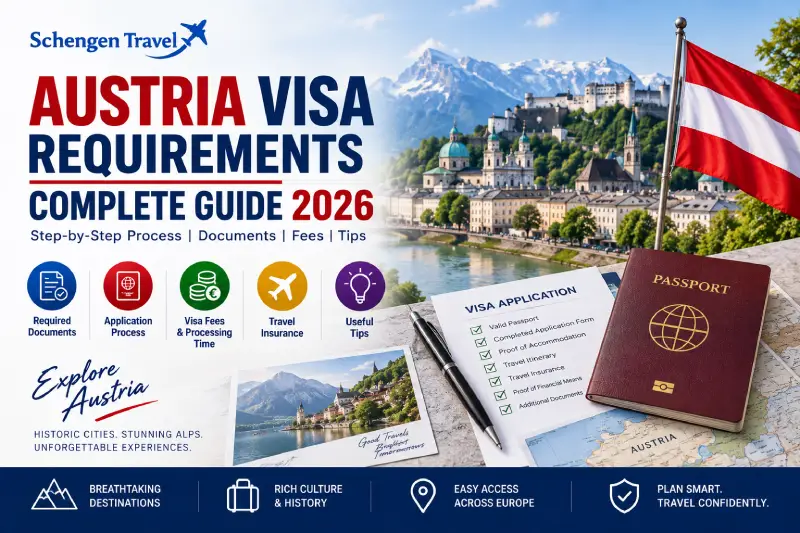
For a standard tourist application, you should generally prepare:
- Completed and signed visa application form
- Valid passport
- Recent passport photograph
- Copy of passport information page
- Previous Schengen visas, where applicable
- Flight reservation or other proof of transport
- Accommodation proof
- Travel medical insurance
- Proof of sufficient financial means
- Employment or income documents
- Evidence of ties to your country of residence
- Additional documents depending on your circumstances
The Austrian government confirms that a paid flight ticket is not generally required as proof of transport. A reservation or booking can be submitted instead.
What Type of Austria Visa Do You Need?
Before preparing documents, identify the correct visa category.
Austria Schengen Visa C
A Visa C is generally used for short stays of up to 90 days within a 180-day period.
It can cover purposes such as:
- Tourism
- Visiting family or friends
- Business travel
- Other permitted short visits
Austria’s official guidance confirms that Visa C is intended for tourism, business and visiting purposes without gainful employment.
Austria Visa D
If you plan to stay in Austria for more than 90 days but no more than six months, you may need a national Visa D instead.
The requirements are different, so this article focuses primarily on the short-stay tourist or visitor visa.
Who Needs an Austria Visa?
Citizens of EU and EEA countries and Switzerland generally do not need a visa to enter Austria.
Citizens of many other countries require a visa before travelling to Austria. Austria’s Foreign Ministry recommends checking the applicable visa requirement based on nationality before starting the application.
If Austria is one of several Schengen countries on your itinerary, you also need to determine which country is responsible for your application.
For example:
Austria: 7 nights
Germany: 3 nights
Italy: 2 nights
Austria is your longest stay and would normally be the main destination.
Your application should reflect your actual travel plans.
Austria Visa Requirements and Documents
1. Completed Visa Application Form
The application form needs to be completed accurately and signed.
Check the following carefully:
- Full name
- Passport number
- Date of birth
- Travel dates
- Purpose of travel
- Accommodation details
- Contact information
The information should match your passport and supporting documents.
A different hotel date or incorrect passport number may look like a small error, but it can create unnecessary questions during processing.
2. Valid Passport
Your passport needs to meet the applicable Schengen requirements.
Austria’s official guidance states that the passport should:
- Have at least two free pages
- Have been issued within the previous 10 years
- Remain valid for at least three months beyond the duration of the requested visa
You should also provide a copy of the passport data page and, where relevant, copies of previous Schengen visas.
Check your passport before making the appointment.
3. Passport Photograph
The photograph should comply with ICAO standards.
The Austrian guidance specifies a colour passport photograph, while the Saudi Arabia tourist checklist specifies a recent 35 × 45 mm photograph with a white or light background.
Avoid submitting an old photograph that no longer represents your current appearance.
4. Flight Reservation for Austria Visa
Flight documentation is one of the most important parts of the travel plan.
Austria’s official visa information states that applicants can provide a reservation or booking, and a paid ticket is not required.
The Austria tourist checklist currently used in Saudi Arabia specifically requests an air ticket reservation including the return flight and reservation details.
A useful reservation should clearly show:
- Passenger name
- Departure airport
- Arrival airport
- Travel dates
- Airline
- Flight numbers
- Return journey
- Reservation details or booking reference
For example:
Departure: Riyadh → Vienna
Date: 10 October 2026
Return: Vienna → Riyadh
Date: 20 October 2026
Your accommodation and insurance should cover the same travel period.
If you do not want to purchase a non-refundable ticket before receiving your visa decision, you can read our detailed guide on flight reservation for visa applications.
5. Accommodation Proof
You need to show where you will stay during the trip.
Depending on your situation, this may include:
- Hotel reservation
- Accommodation confirmation
- Rental agreement
- Invitation from a host
The current Austria tourist checklist for Saudi Arabia asks for a confirmed hotel reservation under the primary applicant’s name or other proof of accommodation covering the whole trip. It also states that hotel vouchers are not acceptable and asks for complete hotel contact details.
Make sure your hotel booking shows:
- Your name
- Hotel name
- Full address
- Check-in date
- Check-out date
- Contact information
If your trip includes Germany or Italy as well as Austria, include accommodation and transport information for those destinations too.
6. Travel Medical Insurance
Travel medical insurance is a mandatory part of the standard Schengen application.
Austria requires insurance that:
- Is valid throughout the Schengen Area
- Covers the intended stay
- Provides at least €30,000 coverage
- Includes medical repatriation
Austria’s official guidance specifically states the €30,000 minimum and the need for medical repatriation coverage.
For a multiple-entry application, the insurance requirement applies at least to the first intended visit under the applicable rules.
Read our detailed guide on travel insurance for a Schengen visa before purchasing your policy.
7. Proof of Sufficient Financial Means
You need to demonstrate that you can financially support yourself during the trip.
Depending on your circumstances, financial evidence can include:
- Bank statements
- Salary slips
- Employment documents
- Pension evidence
- Scholarship documents
- Sponsor documents
Austria does not state one universal bank balance that applies to every applicant. The consulate assesses whether the applicant has sufficient means for living and travel expenses.
Your financial situation should make sense in relation to your itinerary.
For example, a 5-day trip with modest accommodation has different financial requirements from a 30-day multi-country holiday.
Avoid unexplained large deposits immediately before submitting your application.
8. Employment Documents
Employment documents help establish your income and connection to your country of residence.
For an employed applicant, prepare an employer letter showing relevant information such as:
- Position
- Salary
- Employment date
- Purpose of travel
- Approved leave
- Contract details where applicable
The Austria tourist checklist for Saudi Arabia asks for an original employer letter and specifies details including the purpose of visit, position, salary and employment date. It also includes Chamber of Commerce attestation requirements in the relevant cases.
Self-employed applicants may need business registration or trade licence documents
9. Proof of Strong Ties to Your Home Country
Austria’s official visa guidance says applicants may need evidence of their economic, family and social roots in their home country.
Examples include:
- Employment
- Property ownership
- Family ties
- Studies
- Pension entitlement
These documents can help demonstrate that your trip is temporary and that you have reasons to return.
This is particularly important when preparing a first-time application.
10. Previous Schengen Visa Documents
If you have previously received a Schengen visa, include the relevant copies requested by the responsible visa centre or consulate.
Previous travel history can help establish your travel record, but it does not guarantee approval of a new application.
For applicants in Saudi Arabia, the current Austria checklist asks for relevant passport pages and previous Schengen visa copies.
Austria Visa Requirements for Applicants in Saudi Arabia
The documentation can be more specific depending on where you submit the application.
The current Austria tourist checklist for Saudi Arabia provides separate financial requirements for Saudi citizens and non-Saudi residents.
Saudi citizens
The checklist asks for an original bank statement showing regular monthly income or salary for the previous 3 months, stamped by the bank. If the statement does not show regular income, additional evidence such as a credit card statement may be requested.
Non-Saudi residents
The current checklist asks for an original bank statement showing regular monthly income or salary for the previous 6 months, including the current balance.
If regular income is not visible, additional evidence such as the last six months of payslips may be required.
Non-Saudi applicants also need:
- Valid Saudi residence permit
- Valid exit/re-entry visa
- Relevant residence documentation
The current checklist specifies that the residence permit should remain valid for three months after the intended departure from the Schengen area.
Austria Visa Application Process
Once your documents are ready, the basic process is straightforward.
Step 1: Confirm Austria is the correct destination
If you are visiting multiple Schengen countries, make sure Austria is the appropriate country for your application based on your genuine itinerary.
Step 2: Prepare your documents
Organise:
- Passport
- Application form
- Photograph
- Flight reservation
- Accommodation
- Insurance
- Financial documents
- Employment documents
- Supporting documents
Step 3: Book your appointment
Follow the instructions of the Austrian embassy, consulate or authorised visa application centre responsible for your location.
Step 4: Attend the appointment
Bring your original documents and required copies.
Biometric information may be collected unless your previous fingerprints can be reused under the applicable rules. Austria’s current guidance refers to fingerprints collected within the previous 59 months for Schengen applications.
Step 5: Pay the applicable fee
Visa fees and service charges can vary, so check the current instructions for your application location before attending.
Step 6: Wait for the decision
The consulate examines applications individually. Austria states that it assesses the plausibility of the travel purpose, financial means, intention to leave the Schengen Area, and travel insurance among other requirements.
Common Austria Visa Application Mistakes
Applying through Austria when it is not your main destination
Your itinerary should support the country where you submit the application.
Buying a non-refundable ticket too early
Austria’s official information confirms that a paid ticket is not required as proof of transport.
Inconsistent travel dates
Check your:
- Flight
- Hotel
- Insurance
- Employment leave
- Application form
All should describe the same trip.
Weak financial evidence
A large balance without a clear source may not be as convincing as stable income and consistent account activity.
Missing accommodation details
Your hotel documentation should cover the entire trip and clearly identify the accommodation.
Ignoring country-specific requirements
The basic Schengen rules are shared, but the responsible Austrian consulate or application centre can request additional documents.
Austria Visa Requirements Checklist
Before your appointment, check:
- Completed and signed application form
- Valid passport
- Passport copies
- Recent ICAO-compliant photograph
- Previous Schengen visa copies, if applicable
- Return flight reservation
- Accommodation proof
- Travel medical insurance
- Financial evidence
- Employment or business documents
- Proof of residence, where applicable
- Evidence of ties to home country
- Additional documents required for your circumstances
For Saudi applicants, also check the current Austria tourist checklist because it contains specific requirements for Saudi citizens and non-Saudi residents.
Frequently Asked Questions
Do I need a visa to visit Austria?
That depends on your nationality. Citizens of EU, EEA countries and Switzerland do not generally require a visa, while many other nationalities do.
What are the main Austria visa requirements?
The main requirements include a completed application, valid passport, photograph, travel arrangements, accommodation, travel medical insurance, financial evidence and documents supporting the purpose of the trip.
Do I need a confirmed flight ticket for an Austria visa?
You generally do not need to purchase a paid ticket. Austria’s official guidance accepts a reservation or booking as proof of transport.
Is travel insurance mandatory for Austria?
Yes. Standard Schengen applicants need travel medical insurance with at least €30,000 coverage that is valid throughout the Schengen Area and covers the intended stay.
How much bank balance is required for an Austria visa?
Austria does not publish one universal balance that applies to every applicant. You need to demonstrate sufficient funds for your travel and living expenses.
How many months of bank statements are needed?
Requirements depend on the application location. For Saudi Arabia, the current tourist checklist asks for 3 months of statements for Saudi nationals and 6 months for non-Saudi nationals.
Can I apply for an Austria visa if I am a Saudi resident?
Yes, eligible residents can apply from Saudi Arabia. Non-Saudi applicants need to provide valid Saudi residence and exit/re-entry documentation according to the current checklist.
Can I visit Germany or Italy with an Austria Schengen visa?
A valid Schengen visa can generally allow travel within the Schengen Area, subject to its validity, number of entries and conditions. Your original application should still reflect your genuine main destination.
How long can I stay in Austria with a Schengen visa?
A short-stay Visa C permits a maximum stay of 90 days within a 180-day period, subject to the actual duration and conditions granted on your visa.
Can someone sponsor my Austria trip?
Yes. Austria’s official information provides for financial support through an Electronic Declaration of Sponsorship in relevant cases where an applicant cannot demonstrate sufficient personal funds.
Final Checklist Before Submission
Before submitting your Austria visa application, compare every document against your itinerary.
Your:
Flight → Hotel → Insurance → Employment leave → Bank statement → Application form
should tell the same story.
For example, if your flight arrives in Vienna on 10 October, your accommodation should cover that date, your insurance should already be active, and your return journey should be consistent with the rest of your application.
The current Austrian requirements also make clear that visa applications are assessed individually. Meeting the document checklist does not guarantee that a visa will be issued.
For travellers who need a flight document without immediately purchasing a full airfare, a genuine flight reservation can be used where the applicable checklist accepts a reservation. Austria’s own guidance specifically states that presentation of a paid ticket is not required.