
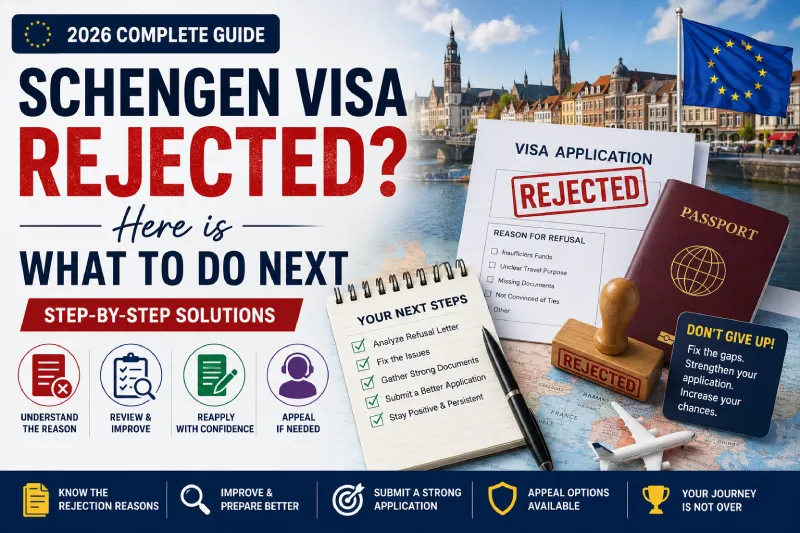

Getting a Schengen visa rejected after weeks of preparation is genuinely demoralising. You collected every document on the list, paid the EUR 90 fee, took time off work for the VFS appointment, and then received a letter telling you no.
Here’s what matters right now: a refusal is almost never the end of the road.
Around 10% of all Schengen visa applications are refused. For applicants from certain countries that number is higher. The vast majority of those refusals are based on specific, fixable issues with the application, not fundamental ineligibility. The key is understanding exactly what went wrong.
This guide covers how to read your refusal letter, what the most common rejection reasons actually mean, and how to build a stronger application the second time.
First: read the refusal letter carefully
This sounds obvious, but it’s the step most people rush through while upset. The refusal letter is the most important document in your reapplication process.
Under Article 32 of the Schengen Visa Code, every refusal must be issued in writing and must state the specific reason or reasons for the decision. The letter will reference one or more of the grounds listed in the Code. Each one points to a different fix.
Look for the checked boxes or numbered reasons. Some letters are detailed. Others are brief. Either way, the reason code is what you need to work with.
Keep the refusal letter. You’ll need to disclose the refusal on future applications. If you appeal, you’ll need to reference the stated reason. If you reapply, a clear understanding of the reason helps you build a file that directly addresses it.
Schengen visa rejected: the 8 most common reasons and what each means
These are the refusal grounds that come up most frequently. Each one points to something specific you can fix.
| Refusal reason | What it means | How to fix it |
|---|---|---|
| Purpose and conditions of stay not justified | The officer wasn’t convinced your trip is genuine or that you’ll leave | Clearer travel itinerary, stronger flight reservation with confirmed return, more detailed day-by-day plan |
| No proof of sufficient means of subsistence | Your financial evidence didn’t demonstrate enough funds | 3 to 6 months of clean bank statements, higher balance, income proof |
| Return journey not confirmed | No confirmed return or onward flight | Submit a verified flight itinerary showing both entry and exit from Schengen area |
| No proof of accommodation | Hotel or host proof was missing, incomplete, or unacceptable | Full hotel reservations for every night, or a proper host declaration |
| Travel medical insurance not provided or insufficient | Insurance was missing, below EUR 30,000, or didn’t cover all Schengen countries | Submit a compliant Schengen insurance policy |
| Information submitted concerning the justification for the purpose and conditions of stay was not reliable | Documents appeared inconsistent, outdated, or insufficient | Address inconsistencies between documents and dates, submit originals |
| Intention to leave before visa expiry not established | Ties to home country were weak or unclear | Stronger employment letter, property documents, family ties evidence |
| Alert in SIS (Schengen Information System) | You appear on a Schengen-wide watchlist or had prior entry issues | Request your SIS data and seek legal advice on contesting the record |
Most refusals fall into reasons 1 through 6. These are all document and evidence issues that a better-prepared application can address. Reasons 7 and 8 are more complex and may benefit from professional immigration advice.
Was your flight itinerary the problem? How to tell
Refusal reasons 1, 2, and 3 in the table above can all relate to your flight document. Here’s how to work out whether it was the issue.
‘Return journey not confirmed’
This is the clearest signal. Your itinerary either didn’t include a return flight, showed a return date too far in the future, or the booking wasn’t verifiable through the Global Reservation System (GRS). Fix: a confirmed reservation with a valid PNR showing both entry into and exit from the Schengen area, with dates consistent with the length of stay you applied for.
‘Purpose and conditions of stay not justified’
This can be a travel itinerary issue. If your flight dates were vague, or your day-by-day plans didn’t align with your accommodation or flight reservation, the officer may have doubted the trip’s credibility. Fix: a specific, verifiable itinerary where all dates line up across flight, hotel, and insurance.
‘Information submitted was not reliable’
This refusal reason usually means the visa officer found some information unclear, inconsistent, or not fully trustworthy. It may happen due to unclear bank statements, mismatched IT returns, incomplete sponsor details, insufficient trip budget, or differences between the documents and interview answers. It can also happen if the applicant was not confident during the interview or gave inaccurate answers. Before reapplying, make sure all documents are clear, complete, verifiable, and match your travel plan.
Was your hotel reservation the problem?
Refusal reason 4 specifically calls out missing or insufficient accommodation proof. But it also comes up within broader refusals about purpose of stay.
Common hotel-related issues that lead to refusal:
- Hotel reservation didn’t cover every night of the planned trip
- Multi-country itinerary had accommodation gaps for some countries
- Free cancellation booking had already expired by the time the file was reviewed
- Airbnb confirmation was submitted to a German consulate that rejected it
- Host declaration was unsigned, undated, or didn’t include proof of the host’s status in the Schengen country
For your reapplication, every night needs to be covered, across every country in your trip. The reservation needs to have a genuine booking reference, not just a screenshot or a price listing.
Was your travel insurance insufficient?
Travel insurance refusals are frustrating because the fix is simple, but only once you know what specifically failed.
The most common insurance-related failures:
- Coverage below EUR 30,000
- Policy only valid for one Schengen country, not all 29
- Repatriation of remains not explicitly included in the policy wording
- Emergency medical evacuation not explicitly stated
- Policy dates didn’t cover the full duration of the trip
- Insurer not recognised or not registered in the home country
- Policy document in a language the embassy couldn’t read
For reapplication: submit a policy that explicitly states EUR 30,000 minimum coverage, covers all 29 Schengen member states, and includes evacuation and repatriation in the wording. Not implied. Actually stated.
Can you appeal a Schengen visa rejection?
Yes. Under the Schengen Visa Code, every applicant has the right to appeal a refusal. The process, timeline, and authority you appeal to depend on which country’s embassy issued the refusal.
| Embassy | Appeal body | Typical deadline | Appeal fee |
|---|---|---|---|
| Germany | Administrative court (Verwaltungsgericht) | 4 weeks from refusal | Varies |
| France | Commission de Recours (CRRV) | 2 months from refusal | None |
| Spain | Spanish embassy administrative review | 1 month from refusal | None |
| Netherlands | Dutch IND review | 4 weeks from refusal | None |
| Italy | Italian consulate review | 30 days from refusal | None |
| Greece | Greek consulate appeal | 30 days from refusal | None |
In practice, many applicants choose not to appeal and instead reapply with a stronger file. Appeals can take months and the outcome depends heavily on the strength of the new evidence you submit.
Appeals tend to be worth pursuing when: the refusal reason was factually incorrect, your circumstances have changed significantly, or you have clear new evidence that directly contradicts the stated grounds for refusal.
For most document-based refusals, reapplying with a corrected file is faster, less expensive, and more likely to succeed than pursuing a formal appeal.
How to reapply with a stronger file
A reapplication isn’t just submitting the same documents again with a new date on them. The officer can see you’ve applied before. They’ll look at what’s different.
Identify every specific reason in your refusal letter. Address each one directly. If there were 3 reasons, your reapplication needs to clearly fix all 3.
Fix the flight itinerary. If your previous itinerary had no verifiable PNR, no return leg, or inconsistent dates, correct all of that. The new itinerary should be from a service that places a real GRS-backed booking.
Fix the hotel reservation. Cover every night. Make sure the dates align precisely with your flight arrival and departure. No gaps, no expired free-cancellation bookings.
Fix the insurance. Submit a policy that explicitly meets every Schengen requirement. EUR 30,000 minimum, all 29 member states, evacuation and repatriation stated.
Strengthen your financial evidence. If the refusal mentioned insufficient funds, 6 months of bank statements rather than 3 make a clearer picture. A consistent salary history carries more weight than a single large balance.
Strengthen your ties to home. A stronger employer letter with explicit return date, updated property documents, or a family commitment letter all help if the officer doubted you’d leave.
Write a cover letter. A brief, factual letter explaining what changed since your previous application, directly addressing the refusal reason, shows the officer you’ve engaged seriously with the feedback.
How long to wait before reapplying
There’s no mandatory waiting period under the Schengen Visa Code. You can reapply immediately after a refusal.
That said, reapplying the next day with the same file makes no sense. The officer can see your previous application, the refusal reason, and how long ago it was. An application submitted 3 days after a refusal with no apparent changes will almost certainly be refused again.
A realistic timeline for most applicants: 2 to 4 weeks to gather corrected documents, fix the specific issues, write a cover letter addressing the refusal, and submit a noticeably stronger file. Some applicants take longer if they need new bank statements to accumulate or a new employer letter to be issued.
If your refusal was based on a SIS alert or a policy-level concern, seek legal advice before reapplying. Those situations need a different approach.
FAQ’S
Can I reapply for a Schengen visa after rejection?
Yes. There is no mandatory waiting period under the Schengen Visa Code. You can reapply as soon as you’ve addressed the specific reasons for your refusal. The key is submitting a noticeably different and stronger file, not the same documents again.
How do I know why my Schengen visa was rejected?
Your refusal letter must state the reason or reasons under Article 32 of the Schengen Visa Code. The letter may list checked boxes corresponding to standardised refusal grounds, or a written explanation. Keep this letter. It tells you exactly what to fix.
Does a Schengen visa refusal affect future applications?
Yes, indirectly. Every Schengen visa application asks whether you’ve previously been refused a visa. You’re required to disclose it. The refusal itself doesn’t permanently disqualify you, but a pattern of refusals without improvement raises questions. Addressing the specific reasons before reapplying is important.
Can I apply to a different Schengen embassy after a refusal?
Only if your trip plan changes and a different country becomes your primary destination. Switching embassies just to avoid a refusal record is not permitted and can be treated as misrepresentation if discovered. Apply through the correct embassy for your trip.
What if I paid for flights and hotels before my visa was refused?
If you used a flight itinerary service like ours, you didn’t pay for the flights themselves, so there’s no loss there. Hotel reservations for visa purposes also don’t involve upfront payment. Travel insurance is typically non-refundable once issued, but the cost is relatively small. Buying real, non-refundable tickets before visa approval is exactly the scenario we advise against for this reason.
How much does it cost to reapply for a Schengen visa?
The full EUR 90 visa fee applies again for each reapplication, plus VFS service fees of approximately EUR 15 to EUR 30. The fee is non-refundable regardless of outcome. This is why fixing the specific issues before reapplying is more cost-effective than a quick retry.
What is an SIS alert and what do I do if that’s the reason?
SIS stands for Schengen Information System. It’s a shared database used by all Schengen member states. An alert in SIS can result from a prior deportation, overstay, or border incident. If your refusal letter cites this as a reason, you have the right to request a copy of the data held about you. This situation typically requires legal advice from an immigration lawyer before any further action.
Does a travel insurance issue from my previous application still affect me?
Only if you submit the same policy again. Fix the insurance document before reapplying. Submit a policy that explicitly meets every Schengen requirement and the previous issue won’t carry forward.
Ready to reapply with the right documents?
GRS-verified flight reservation with confirmed return leg. Hotel reservations for every night of your trip. EUR 50,000 Schengen travel insurance. All three delivered by email with consistent dates across every document.
Flight itinerary only (from $15)
WhatsApp: +1 201-554-8735. Tell us your refusal reason and we’ll confirm exactly what document you need to fix it.