
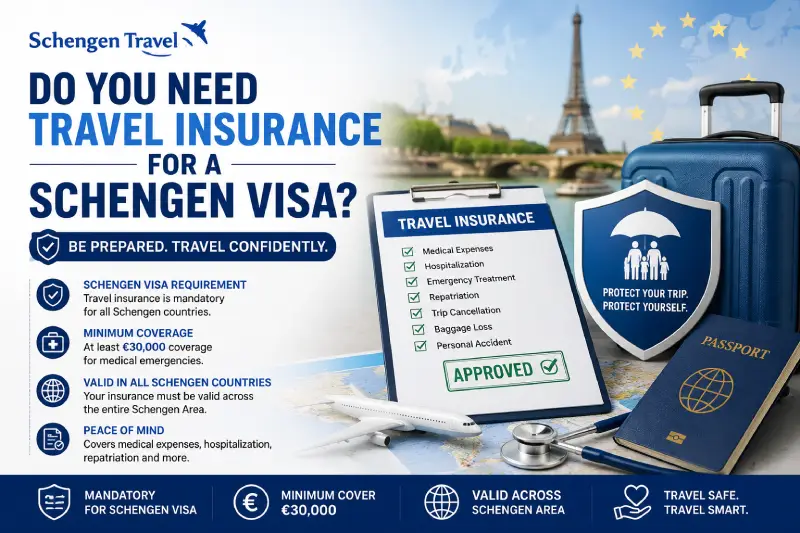

Yes. For most applicants seeking a short-stay Schengen visa, valid travel medical insurance is part of the application requirements.
The policy needs to do more than cover lost luggage or a delayed flight. Under the Schengen Visa Code, it must cover emergency medical treatment, emergency hospital care, medical repatriation, and costs connected with death while you are in the Schengen area. The minimum required coverage is €30,000.
Your insurance also needs to cover the full period of your intended stay and be valid throughout the Schengen territory. For applicants requesting a multiple-entry visa, proof of insurance is generally required for the first intended trip, with the applicant acknowledging the need to remain insured on later visits.
The rules themselves are simple. Problems usually appear in the details: a policy ending a day too early, coverage that applies only in one country, missing repatriation wording, or a certificate that does not clearly identify the traveller.
This guide explains what a compliant policy should show, what €30,000 actually means, when you should buy insurance, and what to check before submitting your application.
Quick answer
For a standard Schengen visa application, your travel medical insurance should normally meet these conditions:
| Requirement | What you need |
| Minimum medical cover | €30,000 |
| Geographic validity | Throughout the Schengen territory |
| Duration | Entire intended stay or transit |
| Emergency treatment | Covered |
| Emergency hospitalisation | Covered |
| Medical repatriation | Covered |
| Death-related repatriation | Covered |
| Applicant name | Clearly stated on certificate |
| Policy dates | Match or cover travel dates |
These requirements come from Article 15 of the Schengen Visa Code.
Is travel insurance mandatory for a Schengen visa?
For applicants seeking a uniform Schengen visa for one or two entries, the Visa Code requires proof of adequate and valid travel medical insurance.
The policy must cover costs that may arise from:
- Medical repatriation
- Urgent medical attention
- Emergency hospital treatment
- Death during the stay
The minimum
coverage is €30,000.
This is a formal visa requirement rather than an optional travel extra.
A standard holiday policy may include many other benefits, such as baggage loss or trip cancellation. Those can be useful, but they do not replace the medical conditions required for the visa.
Who can be exempt?
The Visa Code allows limited exceptions.
Holders of diplomatic passports are exempt from the travel medical insurance requirement. Certain professional groups may also be considered adequately covered when their work arrangements already provide suitable insurance, with seafarers given as an example.
These are narrow cases.
A normal tourist, family visitor, business traveller, or first-time Schengen applicant should expect to provide insurance unless the competent authority says otherwise.
What does Schengen visa insurance need to cover?
A compliant policy needs to cover specific medical risks.
Emergency medical treatment
The policy should cover urgent treatment required because of illness or injury during your trip.
For example, you become seriously ill in France and need emergency medical attention before you can continue travelling.
Emergency hospital treatment
If your condition requires hospital care, the policy needs to provide appropriate medical coverage within its terms.
The Schengen rules specifically refer to emergency hospital treatment.
Medical repatriation
This means returning you to your home country for medical reasons when medically necessary.
A serious accident can make ordinary commercial travel impossible. Medical repatriation may involve medical escorts, special transport, or other arrangements.
That is one reason the minimum insurance requirement is far higher than the cost of a routine doctor’s appointment.
Repatriation following death
The rules also require coverage connected with death during the stay.
The practical purpose is to cover arrangements associated with returning the deceased traveller home when required.
When checking a policy, look for clear wording around repatriation rather than assuming that a generic “medical cover” line includes everything.
Why does Schengen insurance require at least €30,000?
Article 15 sets the minimum coverage at €30,000.
This amount is the minimum legal threshold for the visa requirement.
It is not a daily allowance and it does not mean you must pay €30,000.
It means the insurance must provide at least that level of eligible coverage under the policy.
Can you buy more than €30,000 of coverage?
Yes.
A policy can provide €50,000, €100,000, or a higher medical limit and still satisfy the minimum requirement, provided the rest of the conditions are met.
Higher coverage does not automatically improve your visa application.
The important part is that your policy meets the requirement and clearly states the necessary protection.
Is €30,000 exactly enough?
Legally, it is the minimum specified in the Visa Code.
You do not need to buy a more expensive policy simply because someone claims that an embassy prefers a particular higher number unless the official instructions for your application say so.
This is an area where online advice often becomes unnecessarily dramatic.
Read the embassy or visa-centre checklist and the policy certificate itself.
How long should your travel insurance be valid?
Your insurance must cover the entire period of your intended stay or transit in the Schengen territory.
Suppose your trip is:
Arrival in Paris: 8 September
Departure from Rome: 18 September
Your policy needs to cover that travel period.
A policy ending on 17 September leaves your final day outside the stated insurance period.
Should you add extra days?
Some applicants choose a small buffer because travel plans can shift.
That can be sensible when the cost difference is small, but the legal requirement is to cover the intended period of stay or transit.
Do not randomly extend your insurance dates while leaving your flight and hotel dates unchanged.
Your application should still describe one coherent trip.
Match your policy with the rest of the file
Compare the dates against:
- Flight itinerary
- Hotel bookings
- Visa application form
- Cover letter
- Invitation
- Planned return date
Our Schengen visa documents checklist can help you review these documents together before your appointment.
Does the policy need to cover every Schengen country?
Yes. The Visa Code states that the insurance must be valid throughout the territory of the Member States.
This is important even if you are applying through one country.
For example, suppose your itinerary is:
- France
- Belgium
- Netherlands
A policy limited only to France would not cover the whole planned journey.
Look for wording such as:
- Schengen Area
- Schengen States
- Europe including Schengen countries
The exact wording depends on the insurer, but the geographic scope should clearly satisfy your itinerary and visa requirement.
What if you only visit one Schengen country?
The insurance still needs to satisfy the Schengen visa conditions.
Do not choose a weaker domestic policy simply because your holiday stays within France, Spain, or Germany.
The visa being requested is governed by Schengen rules.
What should the insurance certificate show?
The policy certificate is what you submit.
Before your appointment, check that it clearly shows:
- Your full name
- Policy number
- Insurer name
- Coverage amount
- Coverage dates
- Geographic validity
- Medical benefits
- Emergency treatment coverage
- Repatriation coverage
- Insurer contact information
Your name should match your passport.
The dates should match the journey.
Read the certificate rather than the marketing page
An insurer’s website may say:
“Perfect for European travel.”
That line does not tell the visa officer what your particular policy covers.
Your own certificate should contain the relevant details.
If something important is missing, ask the insurer for a revised certificate or written confirmation.
Medical insurance vs normal travel insurance
The phrase travel insurance can cover many things.
A policy may include:
- Trip cancellation
- Baggage loss
- Delayed baggage
- Missed departure
- Personal liability
- Medical expenses
- Emergency evacuation
- Repatriation
For a Schengen visa, the medical component is the part tied directly to Article 15.
A policy can have excellent baggage and cancellation benefits and still be unsuitable if the medical limit is too low or repatriation is missing.
Do you need baggage cover?
The Schengen Visa Code does not make lost-baggage protection part of the €30,000 medical requirement.
You may still want it for practical reasons.
The same applies to:
- Trip cancellation
- Electronics
- Travel delays
- Rental-car excess
- Adventure sports
Choose those extras based on your trip, not because you assume the embassy requires them.
What about credit card travel insurance?
Some premium credit cards include travel protection.
It may work for your trip, but do not rely on the card name alone.
Check whether the insurer can issue a certificate showing:
- At least €30,000 medical coverage
- Full Schengen geographic validity
- Entire travel period
- Emergency medical care
- Repatriation
- Your name as the insured traveller
Some credit card policies activate only when you purchase part or all of the trip using that card.
Read the terms carefully.
What about your normal health insurance?
Domestic medical insurance may protect you at home but provide little or no overseas cover.
Even an international health plan should be checked against the Schengen travel-medical requirements.
The question is not whether you “have insurance.”
The question is whether the policy you submit meets Article 15 for the journey.
Single-entry and double-entry applications
Applicants for uniform visas allowing one or two entries need adequate and valid insurance for the intended stay or stays.
Your certificate should therefore cover the travel period being used for the application.
If your itinerary includes two separate entries during the intended journey, check that the policy dates and geographic scope cover both.
What about a multiple-entry Schengen visa?
The rule changes slightly.
Applicants for a multiple-entry visa must prove that they have adequate travel medical insurance covering their first intended visit. They also sign a statement acknowledging that insurance will be needed for later stays.
So if you are applying for a one-year multiple-entry visa, you do not necessarily need to buy a one-year continuous insurance policy solely for the application.
You need compliant insurance for the first intended journey under the Visa Code.
For later trips, you remain responsible for having appropriate insurance.
When should you buy Schengen visa insurance?
You need the required evidence when submitting the visa application according to your local checklist.
Buying insurance too early can create problems if your travel dates change.
Buying it at the last minute leaves little time to fix a spelling error or incorrect policy date.
A practical approach is to finalise your intended travel period first.
Then check:
- Flight dates
- Hotel dates
- Insurance dates
- Visa application dates
Our flight reservation for visa guide explains how the flight side of the application should fit into the same timeline.
Should you buy insurance before the flight ticket?
You do not need a fully purchased flight ticket simply to set your insurance dates.
Use the genuine intended travel dates shown in your visa application and supporting itinerary.
Your final ticket can be purchased later according to your visa outcome and travel plans.
What happens if the visa is refused?
This depends on the insurer’s terms.
Some visa-focused insurance products allow cancellation or refunds after a refusal. Others do not.
Before buying, check:
- Refund policy
- Visa-refusal conditions
- Administrative fees
- Deadline for requesting cancellation
- Evidence required
- Whether the policy has already started
Do not assume that “visa insurance” automatically includes a full refund.
If you have already received a refusal, Our guide on what to do after a Schengen visa rejection covers the next steps for reviewing the decision and preparing a stronger file.
Can an insurance mistake cause a visa problem?
Yes.
Insurance is part of the required application evidence.
The most common problems are simple:
Coverage below €30,000
A policy with €10,000 or €20,000 of medical cover does not meet the minimum.
Wrong geographic area
A policy valid only in one destination may fail the Schengen-wide requirement.
Dates end too early
The policy should cover the entire intended stay.
Applicant name is wrong
Check spelling against the passport.
Repatriation is missing
The required scope includes repatriation for medical reasons and expenses connected with death.
Certificate is unclear
When the document does not show the required information, the visa authority may not be able to confirm that the policy satisfies the rule.
Fix uncertain wording before submission.
How to choose medical insurance for a Schengen visa
You do not need the policy with the longest list of benefits.
You need one that clearly fits both the visa rules and your actual trip.
Check these 6 things first
Medical limit
At least €30,000.
Geographic area
Valid throughout the Schengen Member States.
Dates
Covers the entire intended stay or transit.
Emergency care
Urgent medical attention and emergency hospital treatment should be covered.
Repatriation
Medical repatriation and death-related costs need appropriate coverage.
Certificate
The insurer must be able to issue documentation that clearly shows your coverage.
Then compare price, deductible, exclusions, customer support, claims procedures, and any extras that matter to you.
Final travel insurance checklist
Before the appointment, confirm:
- My name matches my passport
- Medical coverage is at least €30,000
- Policy covers the Schengen territory
- Start date covers my arrival
- End date covers my departure
- Emergency medical treatment is covered
- Emergency hospital care is covered
- Medical repatriation is covered
- Death-related repatriation costs are covered
- Policy number is visible
- Insurer details are visible
- Certificate is clear and readable
- Dates match my flight and accommodation documents
- I have checked my embassy or visa-centre checklist
Frequently asked questions
Do you need travel insurance for a Schengen visa?
Yes. Applicants for standard one- or two-entry uniform Schengen visas must generally prove they hold adequate and valid travel medical insurance meeting Article 15 of the Visa Code.
What is the minimum medical insurance for a Schengen visa?
The minimum coverage is €30,000.
Does the policy have to cover all Schengen countries?
Yes. The insurance must be valid throughout the territory of the Member States.
What medical expenses need to be covered?
The Visa Code refers to medical repatriation, urgent medical attention, emergency hospital treatment, and expenses arising in connection with death during the stay.
How long should the policy be valid?
It should cover the full period of your intended stay or transit.
Do I need insurance for a multiple-entry visa?
For the application, multiple-entry applicants need proof of compliant insurance for their first intended visit and acknowledge the need for insurance during subsequent visits.
Do I need €30,000 in my bank account?
No. €30,000 refers to the minimum insurance coverage limit, not the amount of money you personally need to hold.
Can someone else buy the insurance for me?
Yes. The Visa Code allows another person to take out the insurance in the applicant’s name, provided the required coverage conditions are met.
Can I use credit card travel insurance?
Possibly, if it can provide evidence meeting the full Schengen requirements. Check the medical limit, territory, dates, repatriation, activation conditions, and certificate.
Is domestic health insurance enough?
Usually only if it genuinely provides the required overseas travel-medical coverage. Check the policy rather than assuming your normal healthcare plan qualifies.
Does travel insurance guarantee visa approval?
No. It satisfies one document requirement. The visa authority still assesses the rest of the application.
Should my insurance and flight dates match?
They should describe the same intended journey. Your insurance must cover the complete travel period.
What happens if my visa is rejected?
Check the insurer’s cancellation and refund terms. Policies differ.
Conclusion
Travel insurance for a Schengen visa is a formal part of the application requirements, and the core rules are specific.
Your policy should provide at least €30,000 in coverage, remain valid throughout the Schengen territory, cover the full intended stay, and include emergency medical care and repatriation.
Before submitting the certificate, compare it with your flights, accommodation, and application dates. Check your name, coverage amount, policy period, and geographic area one final time.
The policy does not need to be complicated. It needs to meet the rule and accurately cover the trip you intend to make.