
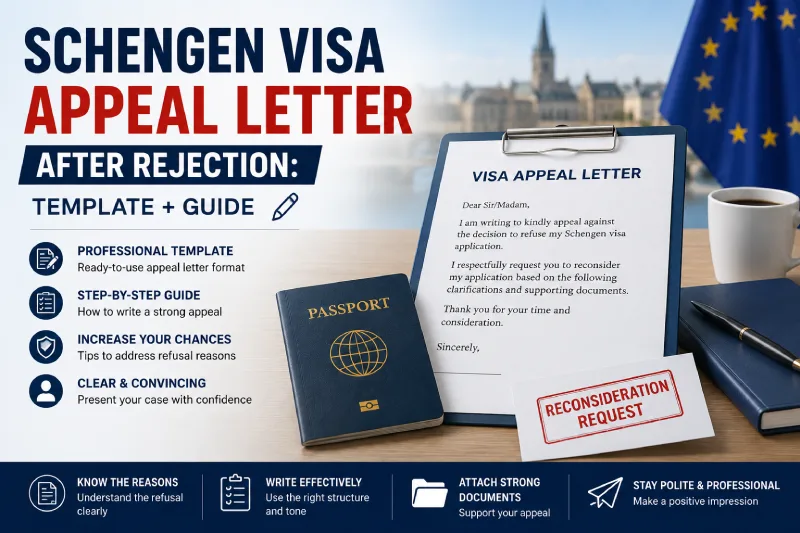

A Schengen visa refusal can feel final when you first read the decision letter. It usually isn’t.
Under the Schengen Visa Code, applicants who receive a refusal have the right to appeal. The appeal is handled under the national law of the country that made the final decision, and the refusal notice should tell you the procedure and deadline that apply to your case.
A strong Schengen visa appeal letter should do more than say that you disagree with the decision. It should address the refusal reason directly, explain why the conclusion should be reconsidered, and point to documents that support your case.
The exact process changes from one Schengen country to another. France, for example, currently gives applicants 30 days to challenge a refusal and requires the appeal to be reasoned, signed, and written in French. Germany changed its system in July 2025 and abolished the previous remonstration procedure, while judicial review and the option to submit a new application remain available.
So the first step is always the same: read your refusal notice carefully.
Quick answer
A Schengen visa appeal letter normally explains:
- Your application details
- The date and reference of the refusal
- The refusal ground you are challenging
- Why you believe the decision should be reviewed
- The evidence supporting your explanation
- Your request for reconsideration
The appeal must follow the deadline, language, authority, and submission method stated in the refusal notice.
A template helps with structure. Your evidence and reasoning decide whether the letter has substance.
Can you appeal a Schengen visa refusal?
Yes.
Article 32 of the Schengen Visa Code states that applicants who have been refused a visa have a right to appeal. The appeal is made against the Member State that took the final decision and follows that country’s national law.
The refusal decision should also give you information about:
- Where to submit the appeal
- How to submit it
- The deadline
- Any language requirement
- The authority responsible
The European Commission’s current FAQ also states that the refusal form should include both the reasons for refusal and the procedure and deadline for an appeal.
That means you should not copy an appeal procedure from a random blog and assume it applies to your case.
Which country handles the appeal?
Appeal against the country that made the final visa decision.
This matters when one Schengen state represents another.
The European Commission gives the example of France representing the Netherlands. If France makes the final refusal decision, the appeal follows the French procedure.
Check the authority named on the decision you actually received.
Should you appeal or submit a new visa application?
Both routes can be available after a refusal.
The better option depends on why the application failed.
An appeal may make sense when
You believe the officer misunderstood evidence already submitted or reached a conclusion that you can challenge with clear documents.
Examples include:
- The refusal says funds were insufficient, but your statements clearly showed adequate funds
- The officer misunderstood your employment situation
- A document was overlooked
- Your travel purpose was supported but interpreted incorrectly
- The refusal concerns your intention to leave, and you have stronger evidence explaining your ties
- An administrative or factual error appears in the decision
A new application may make more sense when
Your original application was genuinely weak or incomplete.
Examples:
- Bank statements were missing
- Accommodation dates were inconsistent
- Travel insurance was unsuitable
- Your itinerary did not support the stated plan
- The cover letter was vague
- An invitation was missing
- Your employment evidence was poor
- Your circumstances have changed materially
The European Commission notes that applicants are free to apply again after refusal and recommends addressing the reasons for the previous decision before submitting a fresh application.
If your main problem was document preparation, your existing guide on what to do after a Schengen visa rejection can help you review the file before choosing your next step.
Read the refusal letter before writing anything
Do not start with a generic template.
Start with the refusal form.
Under the Visa Code, a refusal can be based on grounds such as insufficient justification for the purpose and conditions of the stay, insufficient means of subsistence, doubts about supporting documents, or doubts about whether the applicant intends to leave before the visa expires.
Your appeal should respond to the exact box or explanation selected in your decision.
Create a simple refusal table
Before drafting, write this down:
| Refusal point | What the officer concluded | Your answer | Evidence |
| Purpose of trip unclear | Tourism plan not sufficiently explained | Provide clearer day-by-day itinerary | Hotels, itinerary, bookings |
| Funds insufficient | Available money appeared inadequate | Explain income and savings | Bank statements, salary slips |
| Intention to leave doubtful | Home-country ties considered weak | Explain job, family, property or study obligations | Employer letter, enrolment, ownership evidence |
This prevents the appeal from becoming emotional or unfocused.
What should a Schengen visa appeal letter include?
A clean appeal usually contains seven parts.
1. Your personal details
Include:
- Full name
- Passport number
- Nationality
- Address
- Phone number
Use the same spelling as your passport and visa application.
2. Visa application details
State:
- Visa type
- Application reference
- Application date
- Consulate or visa centre
- Refusal date
This helps the authority identify the file quickly.
3. A clear subject line
For example:
Subject: Appeal against refusal of Schengen visa application [reference number]
Keep it practical.
4. The refusal ground
Quote or accurately summarize the stated reason.
Avoid vague wording such as:
“My visa was refused unfairly.”
Use something like:
“The refusal decision dated 14 July 2026 states that sufficient justification for the purpose and conditions of my intended stay was not provided.”
Now the officer knows exactly what you are addressing.
5. Your explanation
This is the main part of the letter.
Explain:
- What the officer may have misunderstood
- What evidence supports your position
- Why the trip is credible
- Why the refusal ground should be reconsidered
Keep each argument tied to evidence.
6. Supporting documents
Mention each relevant document.
For example:
“I have enclosed my employer’s updated leave approval, salary slips for the last 3 months, and bank statements showing my available balance.”
This makes the appeal easier to review.
7. Your request
End with a clear request for the refusal decision to be reconsidered according to the applicable appeal process.
Avoid demanding approval.
How to write a strong appeal letter
A useful appeal is factual.
It should sound like someone explaining a file to an official, not like someone writing a complaint to customer support.
Address one refusal reason at a time
If your refusal lists two or three grounds, create a separate paragraph for each.
For example:
Purpose of travel
Explain your itinerary, accommodation, and reason for visiting.
Financial means
Explain your income, balance, sponsor, or funding.
Intention to return
Explain your employment, studies, family obligations, business, or other concrete commitments.
This structure makes the letter easy to scan.
Use documents instead of adjectives
Avoid:
“I am a very responsible person with very strong ties to my country.”
Write:
“I have worked as an accounts manager at ABC Ltd. since March 2021. My employer has approved annual leave from 4 to 15 September and confirms that I will resume work on 16 September.”
One specific fact carries more weight.
Explain unusual points
If something in your file could look odd, address it.
For example:
- A large bank deposit
- A recent job change
- A sponsor paying for the trip
- A long travel period
- A multi-country itinerary
- Staying with relatives instead of a hotel
- A previous visa refusal
Do not leave the officer to guess.
Schengen visa appeal letter template
Use this as a structure and adapt it to your refusal.
To: [Appeal authority stated in refusal decision]
Subject: Appeal against refusal of Schengen visa application [reference number]
Dear Sir/Madam,
My name is [full name], passport number [passport number]. I am writing to appeal the refusal of my Schengen visa application submitted on [application date] through [consulate/visa application centre]. I received the refusal decision dated [date].
The decision states that my application was refused because [state the exact refusal reason].
I respectfully request reconsideration of this decision for the reasons set out below.
- [First refusal ground]
[Explain the issue clearly. Refer to the evidence submitted originally and any permitted supporting documents included with the appeal.]
[Example: My purpose of travel is a 10-day tourism visit to France from 5 to 14 September 2026. My itinerary includes accommodation in Paris from 5 to 10 September and Lyon from 10 to 14 September. I have enclosed the corresponding reservations and a revised day-by-day travel plan.]
- [Second refusal ground, if applicable]
[Explain your position and identify the relevant documents.]
[Example: I am employed full-time by ABC Pvt Ltd and have worked there since June 2022. My employer has approved leave for the travel period and confirms that I am expected to return to work on 15 September 2026. I have attached an updated employment letter, leave approval, salary slips, and bank statements.]
I believe the enclosed evidence addresses the concerns stated in the refusal decision.
I therefore respectfully request that my visa application and the refusal decision be reviewed in accordance with the applicable appeal procedure.
Thank you for considering my appeal.
Yours faithfully,
[Full name]
[Passport number]
[Application reference]
[Address]
[Email]
[Phone number]
[Date]
[Signature, if required]
Treat this as a starting point.
Your refusal notice controls the procedure, and some countries may require the appeal in a specific language or format.
Sample response for common refusal reasons
Refusal reason: purpose of travel was unclear
A weak appeal might say:
“I really want to visit Europe for tourism and will return.”
A stronger explanation gives the officer something concrete to review:
“My trip is planned from 7 to 16 October 2026. I will spend 5 nights in Paris and 4 nights in Strasbourg. The attached itinerary lists the planned attractions and transport between both cities. My hotel reservations cover the complete stay, and my return flight reservation departs Paris on 16 October.”
Your Schengen visa documents checklist is useful here because purpose of travel is usually supported by several documents together.
Refusal reason: insufficient financial means
Explain the source of funds.
If the officer saw a large deposit, explain where it came from.
For example:
“The deposit of €2,500 equivalent made on 20 June was the maturity payment from my fixed-term deposit account. I have enclosed the maturity certificate and the corresponding bank entry.”
If someone else is paying for the trip, explain the relationship and include the sponsor evidence required by the consulate.
Avoid simply adding more money to the account without explaining it.
Refusal reason: doubts about your intention to leave
This is often difficult because it concerns the officer’s assessment of your circumstances.
Use concrete ties.
Possible evidence includes:
- Permanent employment
- Approved leave
- Current university enrolment
- Dependent family members
- Active business ownership
- Property or tenancy obligations
- Ongoing professional commitments
Your letter should connect those facts to your return.
For example:
“I am employed as a civil engineer with XYZ Engineering and must return to work on 21 November. My employer’s letter confirms both my position and approved leave period. I am also responsible for an ongoing project scheduled to resume on 22 November.”
Refusal reason: travel itinerary was unreliable
Review every date.
Your flight, accommodation, insurance, invitation, and stated travel period should agree.
If the previous itinerary had an error, say so plainly.
For example:
“The original hotel confirmation incorrectly showed checkout on 12 September although my return flight was on 14 September. I have enclosed the corrected reservation covering the full travel period.”
For flight-related issues, your guide on flight itinerary versus a real flight ticket explains the difference between a reservation and a purchased ticket.
What supporting documents should you attach?
Attach documents that directly answer the refusal.
More paperwork is not automatically stronger.
Possible evidence includes:
For purpose of travel
- Detailed itinerary
- Hotel reservations
- Invitation letter
- Event registration
- Tour booking
- Conference programme
For finances
- Bank statements
- Salary slips
- Employment certificate
- Tax documents
- Sponsor letter
- Sponsor’s financial records
For intention to return
- Employment contract
- Leave approval
- University enrolment
- Business documents
- Family responsibilities
- Property or rental documents where relevant
For travel arrangements
- Updated flight reservation
- Accommodation
- Travel insurance
- Internal transport reservations
Label your attachments clearly.
For example:
Annex 1: Employer letter
Annex 2: Leave approval
Annex 3: Bank statements
Annex 4: Hotel reservations
Annex 5: Flight itinerary
Then refer to those annexes in the letter.
Mistakes that weaken a visa appeal
Copying a generic template word for word
A template does not know why your application was refused.
Adapt every paragraph.
Attacking the embassy
Avoid language such as:
“The officer clearly made an unfair and ridiculous decision.”
Keep the tone professional even when you strongly disagree.
Ignoring the refusal reason
An appeal about your travel plans will not solve a refusal based on finances.
Respond to the actual issue.
Adding unsupported claims
Do not write that you own property, have a job, or hold investments without providing evidence where the claim matters.
Submitting contradictory documents
Check the dates again.
A revised itinerary with one set of dates and an old hotel booking with another can make the appeal worse.
Missing the deadline
This can end the appeal before the merits are even considered.
Use the deadline stated on your refusal notice.
Assuming every Schengen country uses the same procedure
They do not.
National law controls the appeal process.
Country-specific appeal procedures matter
This part deserves attention because online advice is often outdated.
France
France-Visas currently states that a refusal may be challenged within 30 days.
For short-stay visas refused from 1 January 2023, the prior appeal goes to the Deputy Director of Visas. The appeal must be reasoned, signed, and written in French.
Check France-Visas again before filing because procedures can change.
Germany
Germany abolished its remonstration procedure worldwide from 1 July 2025.
The Federal Foreign Office states that judicial review remains available and applicants can submit a fresh visa application after refusal.
Older articles telling applicants to send a German “remonstration letter” may therefore be outdated.
Other Schengen countries
Deadlines, appeal bodies, languages, fees, and submission methods can differ.
Your refusal notice should provide the relevant instructions.
If it is unclear, use the official website of the embassy or immigration authority for the country that made the decision.
What happens after you submit an appeal?
The authority reviews the appeal according to national procedure.
Possible outcomes include:
- The refusal is upheld
- The decision is reconsidered
- Additional evidence is requested
- Further legal review becomes available
- The applicant chooses to submit a new application
Processing times vary.
Avoid buying non-refundable flights while the result remains uncertain unless you are comfortable carrying the financial risk.
Does an appeal guarantee approval?
No.
The appeal gives you a route to challenge the refusal. It does not remove the visa requirements.
Your argument and evidence still need to address the concerns in the original decision.
Will the original visa fee be refunded?
The European Commission states that the visa fee is not refunded when an application is refused. The fee covers examination of the application.
Frequently asked questions
Can I appeal a Schengen visa rejection?
Yes. The Schengen Visa Code gives refused applicants a right to appeal. The process follows the national law of the country that made the final decision.
How long do I have to appeal?
There is no single deadline for every Schengen country. Your refusal notice should state the deadline. France currently uses a 30-day deadline for the appeal procedure described by France-Visas.
Can I use the same appeal letter template for every country?
Use the same basic structure if helpful, but adapt the language, authority, deadline, and submission rules to the country handling your appeal.
Should I appeal or reapply?
Appeal when you have a clear reason to challenge the decision. A new application may be more practical when the first file was incomplete or your circumstances have changed.
Can I send new documents with the appeal?
That depends on the national appeal procedure. Follow the instructions on the refusal notice and the official appeal guidance for the country concerned.
Does Germany still accept visa remonstration letters?
Germany abolished the remonstration procedure worldwide on 1 July 2025. Judicial review remains available, and applicants can also file a new visa application.
What should I write in the first paragraph?
Identify yourself, give your application reference and refusal date, state that you are appealing the decision, and identify the refusal ground.
How long should a Schengen visa appeal letter be?
There is no ideal word count. Most useful letters are concise enough to read easily while giving enough detail to answer every refusal reason.
Should I mention my previous travel history?
Yes, when it directly supports the issue being challenged. For example, previous lawful travel and timely returns may be relevant where the refusal concerns your intention to leave.
Can an appeal make my situation worse?
A truthful and properly filed appeal is part of the legal process. Avoid fabricated evidence or contradictory statements.
Can I apply again while appealing?
Rules and practical considerations can differ by country. Check the official guidance before running both processes at the same time.
Do I need a lawyer?
Many applicants write their own appeal. Legal advice may be useful when the case involves complex immigration history, allegations about document authenticity, legal interpretation, or court proceedings.
Conclusion
A good Schengen visa appeal starts with the refusal letter.
Identify the exact reason, check the appeal procedure and deadline, and build your response around documents that address the officer’s concern. Keep the letter calm, specific, and easy to verify.
A template can give you the structure. Your own circumstances should provide the content.
And check the rules for the country that made the decision before filing. Appeal procedures differ across Schengen states, and recent changes such as Germany’s abolition of visa remonstrations show why old instructions can quickly become unreliable.