
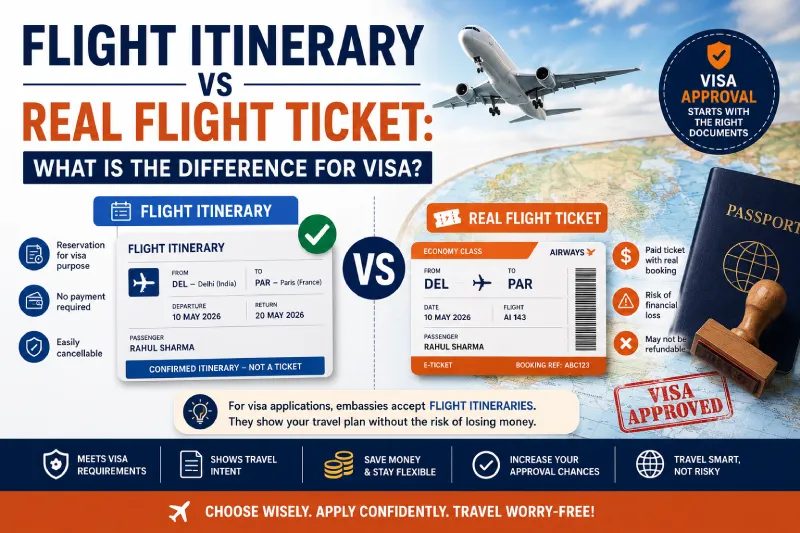

The flight itinerary vs flight ticket for visa question is one of the most searched things in the visa application space. And it’s genuinely confusing because the two documents look almost identical on paper.
Both show a flight route, passenger name, dates, and an airline. The difference is what sits behind the document. One is a purchase. One is a reservation. Embassies want the reservation.
This guide explains exactly what each one is, why the distinction matters, and when (if ever) buying a real ticket makes sense before your visa comes through.
What is a flight itinerary for visa purposes?
A flight itinerary is a confirmed reservation placed inside a real airline’s booking system. It has a 6-character PNR (Passenger Name Record) code, your name, your travel dates, your route, and the airline details.
The key word is confirmed. The reservation exists in the airline’s database. It also shows up in the Global Reservation System (GRS) used by travel agents and embassy consular officers worldwide. Anyone with access to the system can look up your PNR code and see the booking is real.
You haven’t paid for the seat. The airline is holding it as a reservation. That’s standard practice across the travel industry. Airlines hold reservations for corporate bookings, group travel, and visa applications all the time. The booking typically stays active for 7 to 14 days before expiring.
This is also called a dummy ticket, a flight reservation, or an onward ticket depending on where you’re applying. Different name, same document.
What is a real flight ticket?
A real flight ticket is exactly that: a purchased airline ticket where you’ve paid in full (or at least made a binding financial commitment). You receive a ticket number, an e-ticket confirmation, and the seat is yours.
Refundable tickets let you cancel and recoup most or all of your money, usually with a fee. Non-refundable tickets are gone the moment you buy them. If your visa is refused, delayed, or your dates change, a non-refundable ticket is a financial loss with no recovery.
For a Schengen visa application where processing takes 15 to 45 days, and for a US B1/B2 where interviews can be booked 6 to 18 months out, buying a real non-refundable ticket before the visa is approved is a risk most applicants don’t need to take.
Flight itinerary vs flight ticket for visa: the side-by-side comparison
Here’s how the two documents compare across the factors that matter most for a visa application.
| Factor | Flight itinerary (reservation) | Real flight ticket (purchased) |
|---|---|---|
| Cost | $15 to $50 service fee | Full airfare ($200 to $2,000+) |
| Embassy acceptance | Accepted. Preferred by most embassies | Accepted, but not required |
| PNR code | Yes, real and verifiable in GRS | Yes, real and verifiable |
| Financial risk | None. No ticket purchased | High if non-refundable and visa is refused |
| Validity period | 7 to 14 days (airline hold) | Until departure date |
| Embassy recommendation | Most embassies recommend this | Most embassies advise against buying before approval |
| Flexibility | Dates can be adjusted before expiry | Change fees apply, non-refundable fares are fixed |
| What it proves | Your planned travel itinerary | Your planned travel itinerary (same thing) |
The last row is the most important. Both documents prove the same thing to the embassy. The difference is entirely in cost and risk.
What Schengen embassies actually ask for
Spain’s consulate states it directly: “Please provide an email confirmation or website screenshot of your intended flight itinerary. We highly recommend not purchasing your flight tickets until your visa has been approved.”
Germany, France, the Netherlands, Italy, and Greece all follow the same guidance. The Schengen Visa Code requires proof of travel plans, not proof of purchased tickets.
What a case officer checks is whether the travel plan is credible and whether the PNR code is real. A reservation satisfies both. A purchased ticket satisfies both too, but it’s not what’s being asked for and it costs significantly more.
What UK, US, Canada, and UAE embassies ask for
The Schengen zone is the most straightforward on this. Other countries work differently.
UK
The UK Home Office asks for your travel itinerary as part of the Standard Visitor Visa application. A confirmed reservation with a PNR is the accepted format. Real tickets are accepted but not required.
USA
The US B1/B2 process doesn’t list a flight itinerary as a required document, but consular officers ask about your travel plans at the interview. Having a confirmed reservation with specific dates gives you concrete, verifiable answers to those questions. It’s one of the most useful documents you can carry into the room.
Canada
IRCC asks for evidence of your travel plans but doesn’t require a purchased ticket. A confirmed reservation with a PNR satisfies the travel plan evidence requirement.
UAE (Dubai)
The Dubai visa system requires both an inbound and return flight in the reservation. UAE immigration also checks onward travel at the airport. A confirmed itinerary with both legs covers both the application stage and the airport arrival.
Why buying a real ticket before visa approval is a financial risk
Let’s do the actual math.
A non-refundable return flight from Mumbai to Paris costs roughly $700 to $1,200. A Schengen visa takes 15 to 45 days to process. If the visa is refused, that money is gone. If the visa is delayed past your travel date, you may need to rebook at a different price. If your dates change during the process, most airlines charge change fees of $150 to $300.
A refundable ticket solves the risk but not the cost. Fully refundable fares on major routes cost 30% to 80% more than standard economy. You’re paying a premium to protect yourself from a scenario that a $15 to $50 itinerary already handles.
The embassy isn’t asking for your purchase receipt. It’s asking for your travel plan. A reservation delivers that for a fraction of the cost and with zero financial exposure.
When a real ticket actually makes sense
There are situations where buying early genuinely makes sense. Just not for visa purposes.
- After your visa is approved. Once the visa is in your passport, book the real ticket. That’s the right sequence.
- If prices are volatile and you’ve confirmed your dates. Some routes have narrow booking windows for good fares. If you’re certain of your visa and certain of your dates, locking in a fare makes financial sense.
- If you’re using a fully refundable fare and you understand the cancellation terms. Some business travellers do this. Just confirm the cancellation policy before you click buy.
- If the visa is already in hand. If you’re applying for a multiple-entry visa and planning a return trip, buying the ticket for the second trip after the first approval is fine.
The scenario to avoid: buying a non-refundable ticket for a trip that depends on a visa you haven’t received yet. That combination puts unnecessary financial pressure on an outcome that isn’t guaranteed.
FAQ’S
Can I submit a flight reservation instead of a purchased ticket for a visa?
Yes. For Schengen visas, UK visas, Canada visitor visas, UAE visas, and most other visa categories, a confirmed reservation with a valid PNR code is the accepted and preferred document. Most embassies actively advise against buying real tickets before visa approval.
Is a flight itinerary the same as a dummy ticket?
The terms are used interchangeably. A flight itinerary (or dummy ticket, or flight reservation) is a confirmed booking in the airline’s system that hasn’t been paid for yet. A fraudulent version would be a forged PDF with no real booking behind it, which is very different. Legitimate services place real bookings with verifiable PNR codes.
What if the embassy asks for a real ticket specifically?
This is uncommon but does happen with certain visa categories or nationalities. If your specific embassy or visa category requires a purchased ticket, they’ll say so explicitly in their guidance. For the vast majority of tourist and visitor visa applications, a confirmed reservation is what’s asked for.
Does a flight itinerary have a real PNR code?
Yes, if it comes from a legitimate service. The PNR is generated when the booking is placed in the airline’s system. Anyone can verify it on the airline’s website where supported, or it can be checked through the GRS. A forged PDF that has a made-up or copied PNR code will fail this check.
How long is a flight itinerary valid?
Airline reservations are held for approximately 7 to 14 days before the booking expires and the seat is released. Order your itinerary within 1 to 2 weeks of your visa appointment or application submission date, not months in advance.
What does a legitimate flight itinerary look like?
It includes your full name as on your passport, passport number, departure and destination airports, travel dates, airline name, flight numbers, and a 6-character PNR code. You can see examples of our itinerary format before ordering.
Should I buy a real ticket before my Schengen visa appointment?
No. The embassy doesn’t require it and most embassies explicitly advise against it. A confirmed flight reservation handles the requirement at a fraction of the cost. Buy the real ticket after your visa is stamped.
Order your verified flight itinerary
Real booking. Real PNR. GRS-verifiable. No ticket purchase required. No financial risk.
Add hotel reservations and travel insurance in the same order, all with consistent dates.
Flight + Hotel + Insurance (3-hour)
WhatsApp: +1 201-554-8735. Free consultation. Any time zone.