
A visa photo looks like the easiest part of a Schengen application.
Then the photographer asks whether you need 35 × 45 mm or passport size. You notice a shadow behind one ear. Your glasses reflect the studio light. And suddenly a simple photograph becomes one more thing that could delay the appointment.
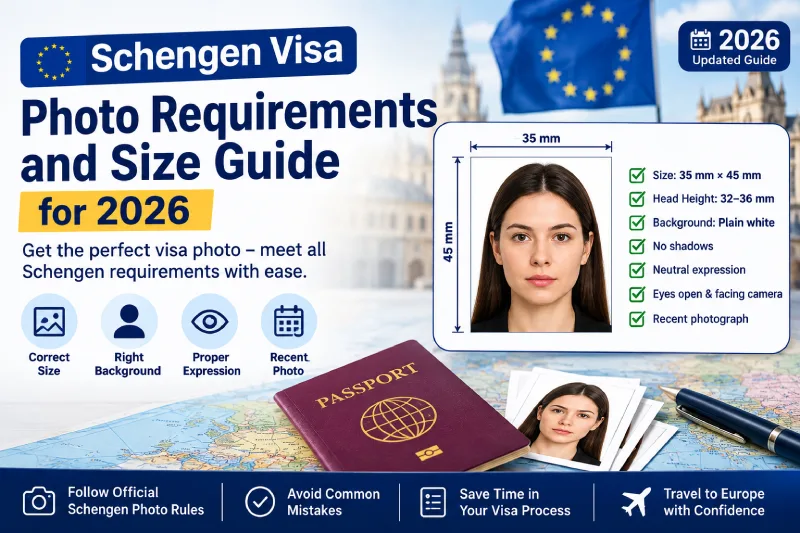
The standard Schengen visa photo requirements usually call for a recent colour photograph measuring 35 × 45 mm. Your face should be centred, clearly visible, evenly lit, and shown against a plain light background.
But local instructions matter.
Some consulates request one printed photo. Others ask for two. Certain visa centres capture a digital photograph during the appointment, which can remove the need to submit a printed copy. Always check the current checklist for the country and application centre handling your file.
This guide covers the standard photo size, facial position, clothing, glasses, head coverings, children’s photos, common rejection reasons, and the checks you should complete before submission.
Quick answer
A standard Schengen visa photo should normally meet these conditions:
| Requirement | Usual standard |
| Photo size | 35 mm wide × 45 mm high |
| Age of photo | Taken within the last 6 months |
| Colour | Colour photograph |
| Background | Plain white or light-coloured |
| Face position | Centred and facing the camera |
| Expression | Neutral, mouth closed |
| Eyes | Open and clearly visible |
| Head covering | Usually removed, except for recognised religious reasons |
| Image quality | Sharp, evenly lit, no shadows or glare |
| Editing | No filters or changes to facial appearance |
Official Dutch Schengen guidance states that a visa photo should be in colour, no more than 6 months old, 3.5 × 4.5 cm, and taken against a white or light-coloured background. Official Polish consular instructions also use the 35 × 45 mm format and require a sharp, front-facing photograph in which the face occupies roughly 70 to 80% of the image.
What is the correct Schengen visa photo size?
The most widely used Schengen visa photo size is:
35 mm wide × 45 mm high
In centimetres, that is:
3.5 cm × 4.5 cm
This is the same format listed by several official Schengen-country authorities, including Dutch and Polish government sources.
Do not assume that a standard passport photo in your home country uses the same dimensions.
For example, photographers in some countries routinely produce square passport photos or 2 × 2 inch photographs. Those may be correct for another destination but unsuitable for a Schengen application.
Tell the photographer clearly:
“I need a 35 × 45 mm biometric photograph for a Schengen visa.”
It helps to show the current checklist from the embassy or visa centre. A photographer may handle several visa formats each day, and the word “passport photo” alone is too vague.
Does every Schengen country use exactly the same size?
Most short-stay Schengen visa instructions use the 35 × 45 mm format.
There can still be local differences in:
- Number of printed photos
- Digital capture procedures
- Background wording
- Whether printed photos are required at all
- Instructions for attaching the photo
- Photo rules for national visas
France-Visas states that the photograph should be between 35 and 40 mm wide and that the face should measure 32 to 36 mm from chin to forehead, excluding the hair. It also requires compliance with ICAO standards.
This is why the local checklist remains your final reference.
How large should your face appear in the photo?
Your head should fill most of the frame without being cropped.
A commonly used standard is for the face or head area to occupy around 70 to 80% of the photograph. Official Polish instructions use this proportion, while France-Visas gives a face measurement of 32 to 36 mm from chin to forehead.
The face should be centred vertically and horizontally.
The photo should show:
- The full face
- The top of the shoulders
- The chin
- The forehead
- Both sides of the face
- The complete outline of the head
The hair may extend near the top of the frame, but the head itself should not be cut off.
Photos that may be refused
A visa centre may reject a photo when:
- The face is too small
- The face fills nearly the entire frame
- The top of the head is cropped
- The chin is cut off
- The head is tilted
- The face is positioned too far left or right
- Too much of the upper body appears
- The camera angle is above or below eye level
A proper biometric photo should look balanced and plain. Creative portrait framing belongs somewhere else.
Background requirements for a Schengen visa photo
Use a plain white, off-white, light grey, or another light background accepted by the relevant authority.
Official Dutch Schengen guidance permits a white or light-coloured background. Polish consular guidance specifies white in some jurisdictions.
The background should have:
- No visible pattern
- No furniture
- No wall texture
- No border
- No objects
- No other people
- No strong colour gradient
- No shadows behind the head
A pale background helps the application system separate the face from the surroundings.
Can the background be blue?
A light blue background may be accepted for certain passport or visa systems, but many Schengen instructions refer to white or light-coloured backgrounds.
White or very light grey is the safer choice when the checklist does not name a specific shade.
Avoid dark blue, red, green, patterned, or studio-themed backgrounds.
Lighting and image quality
Lighting should fall evenly across the face.
Your photo should not contain:
- Flash glare
- Red-eye
- Heavy shadows
- A bright patch on one cheek
- A shadow under the chin
- A shadow on the wall
- Overexposed skin
- Very dark facial areas
The image must be sharp enough for facial recognition and document scanning.
ICAO guidance says the applicant should appear alone, face the camera, maintain a neutral expression, and keep the mouth closed. The guidance also stresses clear visibility of facial details.
Print quality matters
A printed photograph should be:
- Clear
- Properly exposed
- Free from ink marks
- Free from pixels or visible compression
- Printed on suitable photo paper
- Uncreased
- Unstained
- Unaltered
Do not use an office printer unless the local instructions explicitly permit it and the result meets professional photo quality.
Home printing often creates banding, colour shifts, soft edges, or incorrect dimensions.
Facial expression and head position
Look directly into the camera.
Your head should be upright, with your face pointing straight ahead. Both eyes should be at roughly the same height.
Use a neutral expression.
That means:
- Mouth closed
- No broad smile
- No raised eyebrows
- No exaggerated facial expression
- Eyes open
- Jaw relaxed
ICAO photo guidance requires the person to look at the camera with a neutral expression and closed mouth.
A small natural expression may pass in some locations, but a clearly neutral face is safer for biometric matching.
Why smiling can cause trouble
A wide smile changes the shape of the cheeks, eyes, and mouth.
Biometric systems compare facial points. A neutral expression makes those features easier to measure consistently.
Save the holiday smile for the airport photo after the visa arrives.
Eye visibility
Both eyes must be open and visible.
The photo may be rejected when:
- Hair covers one eye
- The eyes are closed or partly closed
- Glasses create glare
- Thick frames cover the eyes
- The applicant looks away from the camera
- The image is too dark around the eyes
Avoid squinting.
Studio lights can be uncomfortable, but the photographer should adjust them rather than asking you to force your eyes open under direct glare.
Can you wear glasses in a Schengen visa photo?
Rules and local practice can differ, so removing ordinary glasses is generally the safest option.
When glasses are worn, they should not:
- Reflect light
- Hide the eyes
- Create shadows
- Have tinted lenses
- Have very thick frames across the eyes
- Change the natural appearance of the face
Sunglasses are unsuitable.
Even clear lenses can reflect the studio light and hide part of the iris. A photo may look acceptable on a phone screen while the printed version shows a bright reflection.
Take the glasses off unless they are medically necessary and the local authority permits them.
What about contact lenses?
Clear contact lenses are unlikely to change your appearance.
Avoid coloured or decorative lenses that alter the natural colour, shape, or visible pattern of the eyes.
The photograph should reflect how you normally look.
Head coverings and religious clothing
Head coverings are generally removed for biometric photographs.
An exception may be allowed for religious reasons, but the entire face must remain visible. ICAO guidance says religious head coverings may be permitted when facial features from the bottom of the chin to the top of the forehead, including both edges of the face, remain clearly shown.
A religious covering should not:
- Cast a shadow across the face
- Cover the eyebrows
- Hide the chin
- Hide the cheeks
- Cover part of the forehead
- Blend into the background
The face should remain evenly lit.
Can you wear a cap or fashion headband?
Caps, hats, large headbands, and decorative coverings should be removed unless a recognised exception applies.
They can hide the hairline, cast shadows, or change the visible outline of the head.
Clothing for a Schengen visa photograph
Wear normal everyday clothing.
Choose a top that contrasts with the background. A white shirt against a white wall can make the shoulders disappear.
Good choices usually include:
- Dark blue
- Grey
- Black
- Brown
- Muted solid colours
Avoid:
- Uniforms, unless required for religious reasons
- Clothing that matches the background
- Large slogans
- Reflective material
- Very bright patterns
- Clothing that covers the chin
The shoulders should be visible, but the photograph should remain focused on the face.
Hair, makeup, and facial hair
Your hairstyle can remain natural as long as it does not hide the eyes or major parts of the face.
Move long hair away from the eyes.
The photograph should still resemble you when you attend the visa appointment and travel.
Makeup
Natural makeup is usually fine.
Avoid makeup that changes facial structure in the photograph, such as:
- Very heavy contouring
- Strong reflective highlighter
- Large false eyelashes that hide the eyes
- Dramatic cosmetic changes
- Digital beauty filters
The purpose of the photo is identification.
Beard or moustache
Normal facial hair is acceptable.
A recent photo is especially useful when your appearance has changed significantly since your passport photograph.
If you have recently grown or removed a large beard, use a photo that reflects your current appearance.
Schengen visa photo requirements for babies and children
Children need photographs that show their current appearance.
The standard is generally more flexible for infants because keeping a baby perfectly still is difficult. Still, the child should appear alone in the photograph whenever possible.
ICAO guidance says the photograph should show the person alone, without chair backs, toys, or other people visible.
For a baby’s photo:
- Use a plain light background
- Keep the face visible
- Remove toys and pacifiers
- Avoid an adult’s hands in the frame
- Keep both eyes visible where possible
- Make sure no blanket covers the face
- Use even lighting
One practical method is to place the baby on a plain white sheet and photograph from directly above.
Does a baby need a neutral expression?
Authorities may accept more natural variation for very young babies.
A newborn may not keep the mouth closed or look directly into the camera. The face should still be clear and unobstructed.
Check the relevant consulate or visa centre instructions before the appointment, especially when applying for an infant.
How recent should the photograph be?
The photograph should usually be no more than 6 months old.
Dutch Schengen instructions and several other official sources use this 6-month limit.
Use a newer photo when your appearance has changed due to:
- Major weight change
- Facial surgery
- A new large facial scar
- Significant hairstyle changes
- Starting or removing a beard
- Changes caused by age or medical treatment
An old photograph may still look good, but the purpose is current identification.
Printed photo or digital photo?
The process depends on the consulate and visa application centre.
Some applicants bring printed photographs. Others have a digital image captured at the appointment.
For example, current Dutch guidance for certain Schengen applications says applicants using an external service provider may not need to submit a photo because a digital photograph is taken during the appointment.
Do not assume this applies everywhere.
Check whether your appointment instructions say:
- Bring one photo
- Bring two photos
- Photo will be captured on-site
- Upload a digital photo
- Attach the photo to the application form
- Leave the photo unattached
Should you glue the photo to the application?
Follow the form and appointment instructions.
Some application forms contain a marked photo box. The centre may prefer the photograph loose, lightly attached, or pasted in that box.
Do not staple it unless the instructions explicitly say to do so. Staples can damage the image.
How many photos are required?
The number can differ by consulate and application location.
You may be asked for:
- One photograph
- Two identical photographs
- No printed photograph because a digital image is captured
Carry one extra identical copy when practical.
A damaged, marked, or incorrectly attached photo can then be replaced without another trip to the studio.
Common reasons a Schengen visa photo is rejected
Photo problems are usually small. They are also easy to avoid.
1. Incorrect dimensions
A square passport photo or 2 × 2 inch image may not fit the required format.
Use 35 × 45 mm unless the local checklist states otherwise.
2. Old photograph
A photo taken more than 6 months ago may no longer reflect your current appearance.
3. Wrong background
Dark, patterned, or coloured studio backgrounds can fail the requirement.
4. Face too small or too large
The head should occupy the expected proportion of the frame.
5. Shadows
Shadows behind the head or across the face can interfere with biometric reading.
6. Smiling or open mouth
A strong smile changes facial measurements.
7. Glasses glare
Reflections may hide the eyes.
8. Hair covering the face
Both eyes and the main facial outline need to remain visible.
9. Poor print quality
Blurred, pixelated, scratched, or faded images may be refused.
10. Digital filters
Skin smoothing, face reshaping, eye enlargement, and background replacement can change the biometric image.
11. Cropped head
The chin, forehead, and outline of the head should remain visible.
12. Another person in a child’s photo
An adult’s hand, shoulder, or face should not appear.
Can a bad photo cause a Schengen visa refusal?
A photo problem will often lead to a request for a replacement rather than a refusal based only on the image.
But it can still cause:
- Appointment delays
- An incomplete application
- A request for a new photograph
- Missed submission deadlines
- A return trip to the visa centre
- Longer processing
A visa application can also be refused for broader reasons unrelated to the photo.
When preparing the rest of your file, use the Schengen visa documents checklist for 2026 to compare the photo requirement with your passport, insurance, accommodation, financial evidence, and travel documents.
Applicants dealing with a previous refusal can review what to do after a Schengen visa rejection before filing again.
Do photo requirements differ by country?
The Schengen visa system follows shared rules, but the practical document checklist is issued through the member state and consular jurisdiction handling the application.
Local differences may cover:
- Number of photographs
- Printed versus digital capture
- Background wording
- Accepted photographers
- Appointment-day procedures
- National visa requirements
- Child-photo guidance
France-Visas, Dutch authorities, and Polish consulates all refer to biometric or ICAO-style photographs, but their public instructions describe measurements and procedures in slightly different ways.
Read the checklist for:
- The Schengen country receiving your application
- Your country of residence
- Your visa category
- The authorised application centre
General blog advice should never replace that checklist.
Schengen visa photo checklist
Review the photograph before leaving the studio.
- Photo measures 35 × 45 mm
- Photo is in colour
- Photo is less than 6 months old
- Background is plain and light
- Face is centred
- Head is upright
- Eyes are open
- Mouth is closed
- Expression is neutral
- No hair covers the eyes
- No glare appears on glasses
- No shadow falls across the face
- Full head and top of shoulders are visible
- Print is sharp and clean
- Image has no filters or manual editing
- Required number of copies is ready
- Local embassy or visa-centre checklist has been checked
It is also worth reviewing the broader Schengen visa application procedure before the appointment so the photo, form, biometrics, and supporting documents are prepared together.
Frequently asked questions
What is the correct Schengen visa photo size?
The commonly required size is 35 mm wide by 45 mm high. Check the local embassy or visa-centre checklist because procedural instructions can differ.
How old can a Schengen visa photograph be?
The photo should usually be no more than 6 months old and should reflect your current appearance.
Can I smile in a Schengen visa photo?
Use a neutral expression with your mouth closed. A broad smile can change facial measurements and may make the photograph unsuitable for biometric use.
Can I wear glasses?
Removing glasses is usually safer. When worn, the lenses must be clear, the eyes must remain visible, and there should be no glare or frame obstruction.
Can I wear a hijab or religious head covering?
A religious head covering may be allowed when the entire face remains visible from the chin to the forehead and both sides of the face are clear.
Is a white background compulsory?
Many authorities request white or light-coloured backgrounds. Use a plain white or very light grey background unless the local checklist gives different instructions.
Can I take the photo with my phone?
A phone image may be suitable only when it meets every technical and biometric requirement and the application accepts digital uploads. A professional visa photographer reduces the risk of incorrect size, shadows, and poor cropping.
Can I edit the background digitally?
Avoid heavy digital editing. Background replacement can create rough edges around the hair or alter the face. Use a proper plain background during the photograph.
How many photos do I need?
The number depends on the consulate and visa centre. Some ask for one or two printed photos. Others capture a digital image during the appointment.
Do children need a visa photo?
Yes, children and babies generally need a current photograph. Requirements may be applied with some flexibility for very young infants, but the face should remain clear and no other person should appear.
Is the visa photo the same as my passport photo?
It may use a similar biometric format, but do not reuse an old passport photo unless it is recent and meets the exact current requirements.
Will VFS take my photograph?
Some external visa centres capture a digital photo during the appointment, while others require printed copies. Check the appointment checklist for your location.
Conclusion
The standard Schengen visa photograph is usually a recent 35 × 45 mm colour image with a plain light background, a centred face, open eyes, and a neutral expression.
The details are simple once you know what to check.
Use a professional photographer familiar with European biometric formats. Review the size before leaving the studio. Check for glare, shadows, incorrect cropping, and facial obstruction. Then compare the result with the current checklist issued by the consulate or application centre handling your case.
A correct photograph will not decide the visa outcome, but it keeps a preventable document problem from slowing down the application.