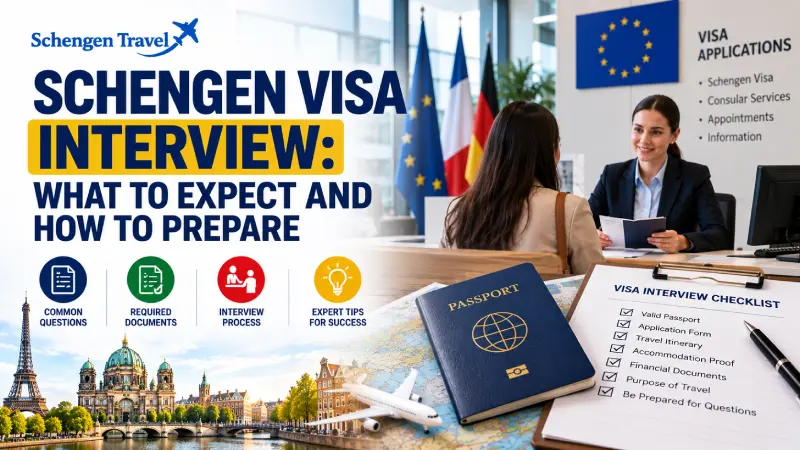

A Schengen Visa Interview is not automatically required for every applicant, but a consular officer can call you for an interview while assessing your application. EU guidance confirms that consular staff may conduct an interview during the examination of a Schengen visa application and may also request additional documents.
If you are asked to attend one, there is usually no reason to treat it like a formal job interview. The officer is primarily trying to understand your application, your travel purpose, your itinerary, and whether the information you provided is accurate and consistent.
The best preparation is therefore not memorising complicated answers. It is knowing your own application.
You should be able to explain where you are going, why you are travelling, how long you will stay, where you will stay, how the trip will be funded, and what you plan to do during the visit.
Your answers should match your documents.
What Is a Schengen Visa Interview?
A Schengen visa interview is a conversation between the applicant and a consular officer as part of the visa assessment process.
It can be used to clarify information such as:
- Purpose of travel
- Planned itinerary
- Accommodation
- Employment
- Financial situation
- Previous international travel
- Family or personal circumstances
- Return plans
An interview is not necessarily a sign that something is wrong with your application.
EU operational guidance states that consular staff may conduct an interview during the examination of an application, regardless of whether the application was submitted directly at a consulate or through an external service provider.
The exact process varies by consulate and application location.
Is a Schengen Visa Interview Mandatory?
No, not for every applicant.
The requirement depends on the consulate, visa application centre, applicant and circumstances of the application.
Some applicants may simply submit their documents and biometrics, while others may be asked additional questions during the application process.
The European Commission’s operational guidance specifically allows consular staff to interview an applicant during examination of the application.
You should therefore prepare for the possibility of an interview even if your initial checklist does not specifically mention one.
If the consulate asks you to attend, follow its instructions carefully.
Why Do Consular Officers Ask Questions?
The interview gives the officer an opportunity to clarify information in your application.
For example, your documents might show:
- A 12-day trip to Italy
- A hotel booking in Rome
- A return flight
- Employment in your home country
- Personal savings covering the trip
The officer may simply ask:
“Why are you travelling to Italy?”
You can answer directly:
“I am travelling for tourism. I plan to spend 12 days in Rome and visit several historical and cultural attractions before returning home.”
There is no need to give a five-minute explanation.
The answer should simply explain the information already contained in your application.
What Should You Know Before Your Interview?
Before attending, review your entire application.
You should know:
Your Travel Dates
Know your exact intended departure and return dates.
Your Destinations
Know the cities and countries included in your itinerary.
Your Accommodation
Know the hotel or host details.
Your Flight Plan
Know your arrival and departure airports, approximate flight times and route.
Your Trip Purpose
Be able to explain why you are travelling.
Your Funding
Know who is paying for the trip and how the expenses will be covered.
Your Employment or Study
Know your employer, job title, leave period or educational details.
Your Previous Travel
If you have travelled internationally before, be familiar with the destinations and dates shown in your application.
You do not need to memorise every line of every document. You simply need to understand the application you submitted.
Common Schengen Visa Interview Questions
The exact questions vary, but many interviews focus on straightforward details about the proposed trip.
1. Why Do You Want to Visit the Schengen Area?
Give a clear reason.
For tourism:
“I am travelling for a holiday and plan to visit France and Italy.”
For a business trip:
“I am travelling to attend a business conference in Germany.”
Your answer should match the purpose stated in your application.
2. Which Countries Are You Visiting?
Know the complete itinerary.
For example:
“I will spend six days in France and four days in Italy.”
If you are visiting several Schengen countries, make sure your answer matches your accommodation and transportation documents.
3. Why Did You Choose These Countries?
A simple explanation is enough.
For example:
“I am interested in European history and architecture, so I planned to visit Paris and Rome.”
Avoid inventing an elaborate story simply to make your trip sound more convincing.
4. How Long Will You Stay?
Give the exact duration shown in your application.
If your application states 12 days, do not suddenly say 18 days during the interview.
5. Where Will You Stay?
Know the name and location of your hotel or the details of your host.
You should be able to explain:
- Hotel name
- City
- Number of nights
- Whether you are staying at multiple properties
Your accommodation evidence should support your answer.
6. Who Is Paying for Your Trip?
Explain whether the trip is:
- Self-funded
- Sponsored by a parent
- Sponsored by a spouse
- Funded by an employer
- Supported by another person
If someone else is paying, understand the sponsor’s relationship to you and which expenses they will cover.
Financial evidence is an important part of a Schengen application.
7. What Do You Do for a Living?
If you are employed, answer clearly:
“I work as a digital marketing manager for a private company.”
You may then be asked about:
- Employer
- Position
- Length of employment
- Monthly income
- Approved leave
Your answer should correspond with your employment documents.
8. When Are You Returning?
Give the planned return date and briefly explain your commitments at home if relevant.
For example:
“My return flight is scheduled for 18 November, and I will return to work after my approved leave.”
Do not make unsupported claims.
Simply explain the actual plan.
How to Answer Schengen Visa Interview Questions
The best approach is simple: answer the question that was asked.
Keep answers clear
Instead of:
“Actually, I have always wanted to visit Europe and there are many reasons why I decided to travel this year…”
Say:
“I am travelling to Italy for a 10-day holiday.”
Be consistent
If your application says 10 days, your interview answer should also reflect 10 days.
Be honest
Do not invent:
- Hotel bookings
- Employment details
- Travel history
- Sponsors
- Family relationships
- Financial information
The interview should explain your application, not create a new one.
Documents You Should Review Before the Interview
Your interview answers should be supported by your application documents.
Review these carefully:
Passport
Check your passport number, issue date, expiry date and previous visas.
Visa Application Form
Review:
- Travel dates
- Destination
- Purpose
- Personal details
- Employment information
Flight Reservation
Check:
- Passenger name
- Departure date
- Return date
- Route
- Airports
- Flight numbers
A flight reservation is one part of the wider travel file. Your itinerary should be consistent with the rest of your application.
You can read our guide on Flight Reservation for Visa: What Embassies Actually Accept for more information.
Accommodation
Know where you will stay on each night of the trip.
Travel Insurance
Check that your insurance covers the intended travel period and Schengen Area requirements. EU/EEAS guidance states that Schengen applicants need appropriate travel medical insurance, with a minimum €30,000 coverage requirement for the applicable short-stay visa situations.
Financial Documents
Review your bank statements and other financial evidence.
You should know:
- Your approximate available funds
- Your regular income
- Who is funding the trip
- Expected travel expenses
Our Proof of Sufficient Funds for a Schengen Visa guide covers this in more detail.
Your Flight Reservation and the Visa Interview
Travel arrangements can come up during the interview.
The officer may ask:
“When are you travelling?”
Your answer should correspond with the flight reservation.
They may also ask:
“Where will you arrive?”
Know the airport and city shown on your itinerary.
For a multi-country trip, be ready to explain the sequence.
For example:
Delhi → Paris → Rome → Delhi
You should know where you enter the Schengen Area, how long you intend to stay in each destination, and where you will leave.
The EU’s Schengen application guidance stresses that supporting documents should establish the purpose and conditions of the intended stay.
That is why your flight, hotel, insurance and itinerary should tell the same story.
What If Your Flight Reservation Changes?
Flight reservations can have limited validity depending on how they were created.
If your reservation changes before the interview, check whether the updated itinerary still matches your application.
Do not manually edit a document to change:
- Dates
- Passenger names
- Flight numbers
- Airports
- Booking references
If a genuine change occurs, obtain an updated document from the booking provider and keep the relevant confirmation.
Your submitted documents should be genuine and accurately represent your intended travel. EEAS guidance specifically advises applicants to provide genuine travel arrangements that match their actual plans.
How to Prepare the Day Before
Do one final review instead of trying to memorise answers.
Check your application
Read the form from beginning to end.
Review your itinerary
Know:
- Entry country
- Main destination
- Cities
- Dates
- Return route
Check accommodation
Make sure you know where you are staying.
Review finances
Know your approximate balance and income.
Organise documents
Keep your documents in a logical order.
Check your appointment details
Confirm:
- Date
- Time
- Location
- Required documents
If the application centre has given you specific instructions, follow those instructions.
What to Wear to a Schengen Visa Interview
You do not need expensive formal clothing.
Choose something:
- Clean
- Neat
- Comfortable
- Appropriate for a formal appointment
The important thing is that you arrive prepared and on time.
Your clothing is not a substitute for proper documentation.
What Not to Do During the Interview
Do Not Memorise a Script
A memorised answer can sound unnatural and may create confusion if the officer asks a follow-up question.
Understand your own itinerary instead.
Do Not Give False Information
Never invent an answer because you think it will improve your application.
Do Not Argue With the Officer
If the officer asks for clarification, answer calmly.
Do Not Guess When You Can Check
If you genuinely do not remember a minor detail, do not invent one.
Do Not Contradict Your Documents
If your hotel booking says Paris but you say you will stay in Lyon, be prepared to explain the difference.
What If You Are Nervous?
Being nervous is normal.
You do not need to speak perfect English or give polished speeches.
Focus on:
Listen → Understand → Answer → Stop
For example:
Officer: Why are you visiting France?
Applicant: “I am travelling for tourism. I plan to spend eight days in Paris.”
Officer: Who is paying for the trip?
Applicant: “I am paying for the trip myself from my salary and savings.”
Officer: Where will you stay?
Applicant: “I have a hotel reservation in central Paris for the full eight-day stay.”
That is enough.
Can a Schengen Visa Interview Cause a Refusal?
An interview itself does not automatically mean approval or refusal.
The visa application is assessed as a whole.
Consular authorities can consider:
- Application form
- Passport
- Supporting documents
- Travel purpose
- Financial evidence
- Accommodation
- Travel arrangements
- Previous travel information
- Answers provided during any interview
EU operational guidance states that consular staff can request additional documents and conduct interviews during examination.
This is why preparing the complete application is more useful than focusing only on possible interview questions.
What If the Officer Asks for Additional Documents?
An officer may request clarification or additional supporting documents.
If this happens:
- Note exactly what has been requested.
- Check the submission deadline.
- Provide genuine documents.
- Make sure the new documents are consistent with the application.
- Keep copies of everything submitted.
Do not replace a requested document with an unrelated document simply because it is easier to obtain.
Schengen Visa Interview Preparation Checklist
Before your appointment, make sure you can answer these basic questions:
- Why are you travelling?
- Which countries are you visiting?
- What are your travel dates?
- How long will you stay?
- Where will you stay?
- Who is paying for the trip?
- What do you do for work or study?
- What is your planned return date?
- What is your travel route?
- Do your flight and hotel dates match?
- Do your financial documents support the trip?
- Do you understand everything submitted in your application?
If you can explain these points naturally, you are already much better prepared.
Frequently Asked Questions
Is a Schengen visa interview mandatory?
No. An interview is not automatically required for every applicant. Consular staff may request an interview during the examination of an application when necessary.
What questions are asked in a Schengen visa interview?
Questions commonly focus on your travel purpose, destinations, dates, accommodation, employment, finances, previous travel and return plans. The exact questions vary by applicant and consular office.
How should I answer Schengen visa interview questions?
Answer clearly, honestly and briefly. Your answers should be consistent with your application and supporting documents.
Do I need to memorise my Schengen visa interview answers?
No. It is better to understand your itinerary and application than to memorise prepared sentences.
Can the officer ask about my flight reservation?
Yes. You may be asked about your travel dates, route, arrival and departure cities or other details connected with your intended journey.
What documents should I review before the interview?
Review your passport, application form, flight reservation, accommodation, travel insurance, financial evidence, employment documents and other supporting documents required for your application.
What if I do not understand an interview question?
Ask the officer to repeat or clarify the question. It is better to request clarification than to give an unrelated answer.
Can I be asked for additional documents after the interview?
Yes. Consular staff may request additional documents during the examination of a visa application.
Final Preparation: Focus on Your Actual Application
A Schengen visa interview is easier to approach when you stop treating it like an exam.
You do not need a perfect speech. You need a clear understanding of the trip you have submitted.
Know your:
- Travel purpose
- Dates
- Destinations
- Accommodation
- Flight route
- Funding
- Employment or study details
- Return plans
Then make sure those answers agree with your documents.
Your flight reservation, hotel booking, insurance, financial records and application form should describe the same trip. Our Schengen Visa Documents Checklist 2026 can help you review the wider document set before submission.
If you are preparing your travel documents, you can also read Flight Itinerary for a Visa: Dummy Ticket vs Real Booking Explained to understand how travel evidence fits into the application.
The interview is only one part of the process. A complete, accurate and consistent application gives the consular officer a clear picture of your proposed trip.