
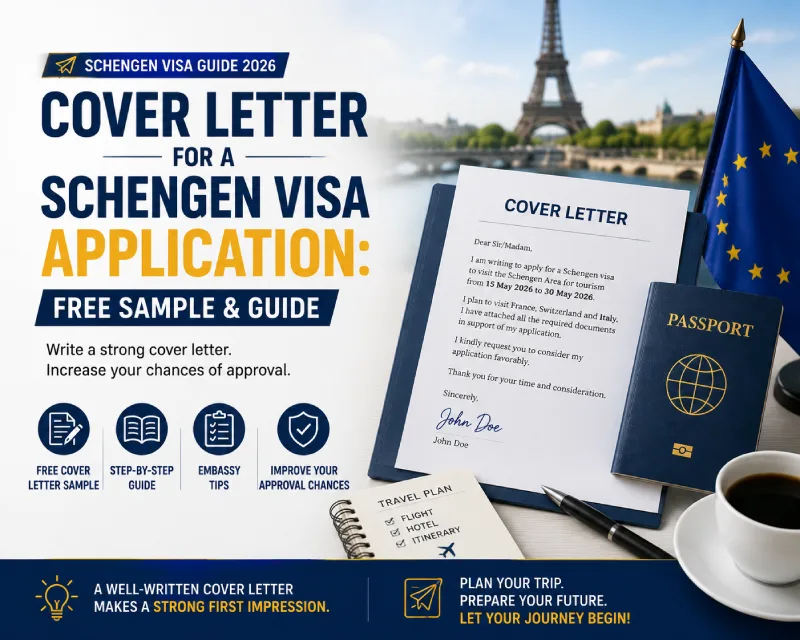

A Schengen visa application can contain dozens of pages: bank statements, hotel confirmations, flight details, insurance, employment records, and the application form itself.
A good cover letter for a Schengen visa gives those documents context.
It tells the visa officer why you’re travelling, when you’re going, how the trip will be funded, where you’ll stay, and why the information across your supporting documents fits together.
A cover letter isn’t listed as a universal mandatory document for every Schengen application. Official EU guidance says supporting documents depend on the purpose of the stay and generally cover the purpose of travel, financial means, accommodation, and evidence of the applicant’s intention to return
That makes the cover letter useful when your file needs explanation. It can be especially helpful for multi-country trips, sponsored visits, unusual bank transactions, self-employed applicants, family visits, or any application where the documents won’t explain themselves at first glance.
Quick answer
A Schengen visa cover letter should usually explain:
- Who you are and which visa you’re applying for
- Why you want to travel
- Your intended travel dates
- Which countries or cities you plan to visit
- Where you’ll stay
- Who will pay for the trip
- Your employment, business, or study situation
- Why you’ll return after the trip
- Any unusual point in the application that needs clarification
Keep it factual. A clear one-page or two-page letter is usually more useful than a long personal story.
What is a cover letter for a Schengen visa?
A visa cover letter is a short written explanation submitted with your supporting documents.
Think of it as the page that connects the pieces of your application.
Your application form might state that you’re travelling to France from 8 to 17 October. Your hotel confirmations show stays in Paris and Lyon. Your flight reservation shows arrival in Paris and departure from Lyon. Your employment letter confirms approved leave for the same period.
The cover letter explains that journey in a few paragraphs.
It can also clarify things that aren’t obvious from individual documents.
For example:
“My employer approved leave from 7 to 18 October. My flight departs India on 7 October and arrives in Paris on 8 October due to the overnight journey.”
That one sentence explains why your employment leave begins a day before the hotel booking.
Before writing the letter, review your complete Schengen visa documents checklist so the dates and information used in the cover letter match the rest of your file.
Is a Schengen visa covering letter mandatory?
There is no single Schengen-wide rule saying every short-stay applicant must submit a personal cover letter.
The standard Schengen application process requires documents supporting the purpose of the stay, financial means, accommodation, and intention to return. The precise supporting-document list can vary according to the trip, applicant category, consulate, and jurisdiction.
France-Visas, for example, directs applicants to its visa wizard because the documents required depend on the stated purpose of travel.
So check the checklist issued for your application.
Even when a personal letter isn’t specifically required, it can be useful when your circumstances need explanation.
When is a cover letter particularly useful?
Consider adding one when:
- You’re visiting several Schengen countries
- Someone else is sponsoring the trip
- You’re self-employed
- You recently changed jobs
- Your bank statement contains a large recent deposit
- You’re staying partly with family and partly in hotels
- Your arrival and accommodation dates need explanation
- You’re travelling for a specific family event
- Your itinerary involves several flights or internal journeys
- You had a previous visa refusal
- Your travel purpose isn’t obvious from one document
If your file is simple, the letter can remain very short.
What should a Schengen visa cover letter include?
A clean letter normally has several core parts.
Your personal information
At the top, include:
- Full name
- Passport number
- Nationality
- Address
- Email address
- Phone number
- Date
Use exactly the same name shown in your passport.
Embassy or consulate details
Address the letter to the embassy, consulate, or visa section handling the application.
For example:
To:
The Visa Officer
Consulate General of France
[City]
If you apply through an external visa centre, the final visa decision is still made by the competent consular authority, not the application centre.
Subject
Keep the subject simple.
For example:
Subject: Application for a Short-Stay Schengen Visa for Tourism
Or:
Subject: Cover Letter for Schengen Visa Application, Passport No. XXXXXXXX
Purpose of travel
Explain why you’re travelling.
Avoid vague lines such as:
“I have always dreamed of visiting beautiful Europe.”
Write:
“I plan to visit France for tourism from 8 to 17 October 2026, with stays in Paris and Lyon.”
The second sentence gives the officer usable information.
Travel itinerary
Summarize your route.
You don’t need to repeat every attraction listed in a detailed itinerary.
For example:
“I will arrive in Paris on 8 October and stay until 13 October. I will then travel by train to Lyon, where I will stay until my departure on 17 October.”
Make sure those dates match your actual bookings.
If your application includes a flight itinerary, check the difference between a flight reservation and a paid flight ticket before describing the document in your letter.
Funding
Explain how the trip will be paid for.
For example:
“I will fund the trip using my salary and personal savings. I have enclosed my recent bank statements, salary slips, and employment certificate.”
For a sponsored trip:
“My father, Mr. Arun Mehta, will fund my airfare and accommodation. His sponsorship letter, bank statements, proof of income, passport copy, and proof of our relationship are enclosed.”
The evidence matters more than the wording.
Your reason for returning
If useful, briefly describe your commitments at home.
For an employee:
“I am employed as a Senior Accountant with ABC Pvt. Ltd. and have approved annual leave for the travel period. I am scheduled to resume work on 19 October 2026.”
For a student:
“I am currently enrolled in the second year of my bachelor’s programme, with classes resuming on 21 October.”
Use facts you can support.
How to write the letter step by step
Step 1: Read your visa checklist
Check what the consulate asks for before drafting anything.
Official EU guidance makes clear that supporting documents depend on the purpose of the proposed stay.
Step 2: Put all your dates in one place
Create a small note with:
- Departure date
- Arrival date
- Hotel check-in
- Hotel check-out
- Insurance dates
- Return flight
- Leave dates
- Invitation dates
Use that note while writing.
Step 3: Explain the trip in chronological order
Start with arrival and finish with departure.
This is easier to follow than jumping between hotels, sponsors, and flight details.
Step 4: Mention the financial arrangement
State who is paying and point to the documents that prove it.
Step 5: Explain anything unusual
If your bank statement contains a large deposit, explain the source.
If your host provides accommodation for only part of the trip, explain where you’ll stay for the remaining days.
If you were previously refused, don’t hide it.
Step 6: Review every claim
Anything important stated in the letter should match the supporting evidence.
Free sample cover letter for a Schengen tourist visa
To:
The Visa Officer
[Embassy/Consulate of Country]
[City]
Subject: Application for Short-Stay Schengen Visa for Tourism
Dear Visa Officer,
My name is [Full Name], passport number [Passport Number], and I am applying for a short-stay Schengen visa for a tourism trip to [Country] from [Arrival Date] to [Departure Date].
I plan to arrive in [City] on [Date] and stay at [Hotel Name] until [Date]. I will then travel to [Second City, if applicable], where I will stay at [Accommodation]. My return flight is planned from [City] on [Date].
The purpose of my visit is tourism. During the trip, I plan to visit [briefly name 2–4 major places or activities].
I am currently employed as [Job Title] with [Company Name], where I have worked since [Date/Year]. My employer has approved annual leave from [Date] to [Date], and I am expected to resume work on [Date].
I will personally fund my travel using my salary and savings. I have enclosed my bank statements, salary slips, employment letter, leave approval, accommodation confirmations, travel medical insurance, and flight itinerary as supporting evidence.
I respectfully request that my application be considered for the proposed travel period. I will comply with the conditions of the visa and return to [Home Country] at the end of my visit.
Thank you for considering my application.
Yours faithfully,
[Full Name]
[Passport Number]
[Phone]
[Email]
[Date]
Sample cover letter for visiting family
A family visit needs slightly different wording because the host and relationship are important.
Subject: Schengen Visa Application for Family Visit
Dear Visa Officer,
I am applying for a short-stay Schengen visa to visit my sister, [Host’s Name], who lives in [City, Country], from [Date] to [Date].
During my stay, I will live with her at [Full Address]. I have enclosed her invitation letter, copy of her passport/residence document, and supporting accommodation documents.
I am employed as [Position] at [Company] and have approved leave for the travel period. I will fund my airfare and personal expenses from my savings, while my sister will provide accommodation.
I plan to return to [Home Country] on [Date] and resume work on [Date].
Please find the supporting documents attached to my application.
Yours faithfully,
[Name]
Official Schengen guidance recognises that supporting evidence varies with the purpose of the journey, including family visits.
Sample wording for a sponsored trip
When someone else pays, be specific about what they’re covering.
“My trip will be sponsored by my father, Mr. Rajesh Sharma. He will cover my round-trip travel, accommodation, and daily expenses. I have enclosed his signed sponsorship letter, bank statements, employment documents, passport copy, and evidence of our relationship.”
Avoid saying only:
“My father is sponsoring me.”
Explain the arrangement.
Sample wording for a self-employed applicant
Self-employed applicants don’t have employer leave letters, so explain your business position.
For example:
“I am the owner of XYZ Digital Solutions, registered in India since 2019. I manage the business full-time and have enclosed the registration certificate, company bank statements, tax records, and supporting business documents. My business operations will continue under my team during my trip, and I will resume my regular duties on 18 November.”
Keep the explanation connected to documents.
Cover letter for a multi-country Schengen trip
A multi-country trip needs a particularly clear itinerary.
Suppose you’re travelling for 12 nights:
- France: 6 nights
- Belgium: 2 nights
- Netherlands: 4 nights
Your letter could say:
“My main destination is France, where I will spend 6 nights. I will arrive in Paris on 3 September and remain there until 9 September. I will then travel to Brussels for 2 nights, followed by Amsterdam for 4 nights. My return flight departs Amsterdam on 15 September.”
The letter helps the officer see why you’re applying through the selected Schengen country.
Official Schengen guidance says applications are normally lodged with the competent consulate based on the destination rules applicable to the trip.
How to explain a previous Schengen visa refusal
Keep it short and factual.
For example:
“My previous Schengen visa application submitted in March 2026 was refused because the purpose and conditions of the intended stay were considered insufficiently documented. For this application, I have provided a detailed itinerary, complete accommodation confirmations, updated financial records, employment documents, and supporting travel evidence.”
If you’re still dealing with the previous decision rather than submitting a new application, review your guide to a Schengen visa appeal letter after rejection before choosing your next step.
Don’t attack the previous decision.
Show what changed.
Common cover letter mistakes
Copying a template without editing it
A template containing another person’s hotel, employer, or travel dates is worse than having no letter at all.
Check every placeholder before printing.
Writing a long personal story
The officer needs facts related to the visa application.
Your childhood dream of seeing the Eiffel Tower probably doesn’t need four paragraphs.
Giving dates that don’t match
This is the biggest practical problem.
Check the letter against:
- Flight itinerary
- Hotels
- Insurance
- Leave approval
- Application form
Making unsupported financial claims
Writing “I have sufficient funds” carries little weight.
Show the financial documents requested for your application.
Using exaggerated promises
Avoid statements such as:
“I guarantee 100% that I will leave Europe.”
Use evidence of your circumstances instead.
Calling a reservation a confirmed paid ticket
Describe your travel document accurately.
Adding documents that contradict the letter
Read the complete file once before submission.
A clean cover letter cannot repair contradictory evidence.
Final Schengen visa cover letter checklist
- Name matches passport
- Passport number is correct
- Correct embassy or consulate is addressed
- Visa purpose is clearly stated
- Arrival and departure dates are correct
- Main destination is explained
- Accommodation matches the itinerary
- Funding arrangement is clear
- Employment, study, or business position is accurate
- Any sponsorship is explained
- Unusual financial activity is clarified where relevant
- Previous refusal is addressed if necessary
- Flight dates match
- Hotel dates match
- Insurance dates match
- Letter is signed where appropriate
- Local document checklist has been checked
Frequently asked questions
Is a cover letter mandatory for a Schengen visa?
There is no universal requirement that every Schengen applicant submit a personal cover letter. Supporting documents vary according to the purpose of travel, applicant category, and consular checklist.
How long should a visa cover letter be?
Keep it concise. One page is often enough for a simple tourist application. A more complex trip may need two pages.
Should I write the letter by hand?
A typed letter is cleaner and easier to read. Sign it if the application instructions require or permit a signed letter.
Who should the letter be addressed to?
Address it to the visa officer or visa section of the competent embassy or consulate.
Can I use the same letter for France, Germany, Italy, or Spain?
Use the same basic structure, but change the destination, authority, travel plan, and any country-specific details. Check the local checklist before submission.
What should I write if someone is sponsoring my trip?
Name the sponsor, explain your relationship, state what expenses they’ll cover, and refer to the supporting financial and relationship documents.
What should a self-employed applicant write?
Explain the business, your role, how long it has operated, how the trip will be funded, and why you’ll return to continue running it.
Should I mention my flight reservation?
Yes, when it helps explain your planned dates and route. Describe it accurately as a reservation or itinerary if the ticket hasn’t been issued.
Do I need to list every tourist attraction?
No. Mention the general purpose and major destinations. Put detailed day-by-day activities in a separate itinerary if needed.
Should I explain a large bank deposit?
Yes, when it could raise questions. Give the genuine source and include evidence.
Should I mention a previous refusal?
If you’re submitting a fresh application after refusal, briefly acknowledge it and explain how the problem has been addressed.
Can a good cover letter guarantee visa approval?
No. A letter helps explain the file. The decision depends on whether your application satisfies the applicable visa requirements.
Conclusion
A good cover letter for a Schengen visa makes your application easier to understand.
Keep it practical. State your travel purpose, dates, route, funding, accommodation, and circumstances at home. Explain anything unusual and make sure every important statement agrees with the supporting documents.
Use the sample as a framework rather than copying it word for word.
And before submission, read the current checklist issued by the embassy, consulate, or authorised application centre handling your case. Schengen supporting documents vary by purpose and jurisdiction, so the local instructions should always guide the final application.


