
Travel insurance for Schengen visa applications is one of those requirements people underestimate right up until the embassy rejects their file for it.
Unlike flight itineraries or bank statements, the insurance requirement has specific numerical thresholds. The coverage amount, the geographic validity, the policy inclusions. All of it is specified in the Schengen Visa Code and checked against that standard at every embassy.
This guide covers exactly what the minimum requirements are, what embassies actually look for when they review your policy document, which types of insurance get rejected and why, and how to get a compliant policy without overpaying.
Minimum requirements for travel insurance for Schengen visa
The Schengen Visa Code sets the baseline. Every member state embassy applies the same standard, though some add stricter conditions on top of it.
| Requirement | What it means |
|---|---|
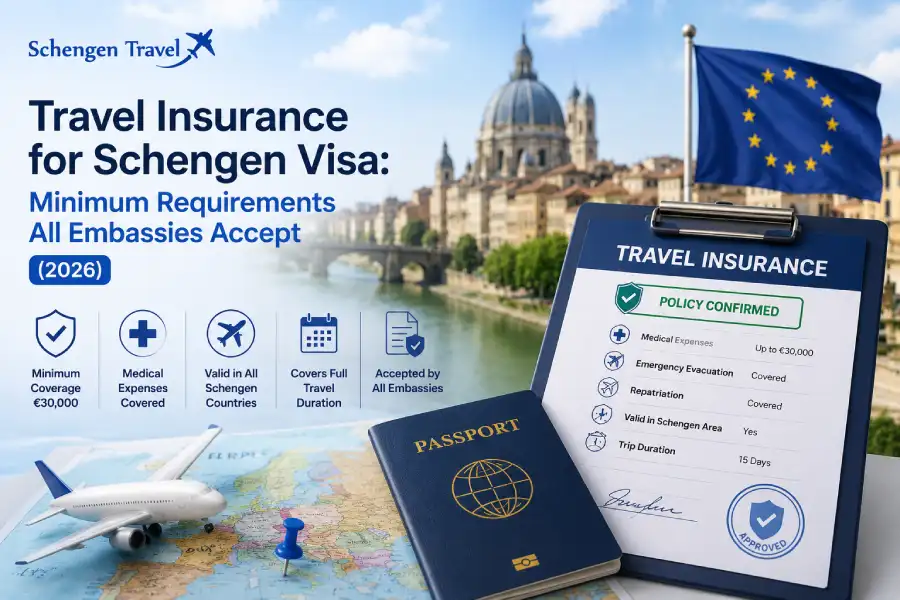
| Minimum medical coverage | EUR 30,000 (approximately $32,500 USD). This is the hard floor. Policies below this amount are rejected. |
| Geographic validity | Must cover all 29 Schengen member states, not just your primary destination country. |
| Trip duration coverage | Valid for every day of your intended stay. A policy that expires 2 days before your return flight fails the requirement. |
| Emergency medical evacuation | Must be explicitly included in the policy. Not implied. It must be stated in the policy document. |
| Repatriation of remains | Required in the policy wording. Covers the cost of returning a deceased person’s remains to their home country. |
| Policy language | Must be in English or the official language of the embassy’s country. Untranslated policies in other languages are not accepted. |
One thing that catches applicants off guard: EUR 30,000 is the minimum across all member states, but some embassies specify higher amounts for certain nationalities. Germany and France occasionally flag applications where the coverage sits exactly at the minimum, particularly for first-time applicants. Having EUR 50,000 to EUR 100,000 of coverage costs only marginally more and removes any doubt.
Our Schengen insurance policy covers EUR 50,000, which exceeds the minimum requirement at every embassy worldwide.
Which Schengen embassies check insurance most strictly?
All of them check. Some go further.
Germany
Strict on the full requirement list. German embassy caseworkers verify coverage amount, geographic scope, and that emergency evacuation is explicitly worded in the document. A policy that says ’emergency medical cover’ without specifying evacuation separately has been returned.
France
Checks coverage amount and the insurer’s registration status. Some VFS Global application centres in high-volume countries run a basic check on whether the insurance company is recognised by French authorities.
Netherlands
Particular about the full geographic validity. Policies that list specific countries rather than ‘all Schengen member states’ have been flagged when the applicant’s itinerary included a country not named in the policy.
Spain and Italy
Generally accept standard compliant policies without additional scrutiny. Still verify coverage amount and dates against the application.
Greece and Portugal
Pragmatic about it. Standard EUR 30,000 policy with correct dates, clear coverage wording, accepted without issue in most cases.
The practical rule: write your policy against Germany’s standard. If it passes that, it passes everywhere.
What the insurance document needs to show
The embassy doesn’t look at your insurer’s website. They look at the policy document you submit. That document needs to clearly show all of this:
- Your full name exactly as on your passport
- Policy number
- Coverage start and end dates that match or exceed your visa application dates
- Coverage amount in EUR : stated clearly, minimum EUR 30,000
- Geographic validity : must say ‘Schengen area’ or list all member states, not just your destination country
- Emergency medical evacuation : stated explicitly, not implied
- Repatriation of remains : explicitly included
- Insurer name, registration number, and contact details
- Document issued in English or the embassy’s official language
If any of these are missing from the document, the embassy will request a revised certificate. That delays your application and sometimes means starting the insurance purchase process again.
Types of insurance that get rejected
Not every policy that uses the word ‘travel insurance’ meets the Schengen standard. These are the types that consistently fail.
Credit card travel insurance
Some credit cards include travel protection as a benefit. Most of these policies don’t meet the Schengen requirements. They often cap medical cover at amounts below EUR 30,000, exclude repatriation of remains, or apply only to trips paid for on that specific card. Read the certificate carefully before relying on it.
Domestic health insurance policies
If you have a national health plan or a domestic medical insurance policy from your home country, it doesn’t cover you in the Schengen area. Embassies require a policy specifically valid for international travel in the Schengen zone.
Single-country policies
A policy that covers only France, or only Germany, is insufficient for a multi-country Schengen trip. The policy must explicitly state Schengen-wide coverage or list all member states. If your trip takes you from Paris to Amsterdam for 2 nights, a France-only policy leaves those 2 nights uninsured in the embassy’s view.
Policies with coverage below EUR 30,000
Budget travel insurance policies sold in some markets cap medical cover at USD 10,000 or USD 15,000. These fail the Schengen requirement regardless of what else they include. EUR 30,000 is the floor and it’s non-negotiable.
Policies not in English or the embassy language
A policy certificate entirely in Arabic, Hindi, or Mandarin without an English translation will be returned. Most international insurers issue documents in English. If yours doesn’t, request an English-language version before submitting.
How long does your insurance need to be valid?
It needs to cover your entire trip from entry to exit, plus a small buffer.
Most embassies accept a policy that begins on your flight departure date and ends on your return date. Some recommend extending it by 15 days beyond your planned return, particularly if your itinerary might shift due to delays or visa-related rebooking.
If you’re applying for a multiple-entry Schengen visa, the insurance needs to cover the specific trip you’re applying for. You don’t need a year-long policy for a 10-day trip, but if you plan to visit Schengen countries multiple times within a year, an annual multi-trip policy often works out cheaper and covers each individual trip without reapplying each time.
One thing that trips people up: if you extend your stay in Europe after your visa start date, your insurance must be extended too. A policy that was valid for June 1 to June 15 doesn’t cover you if you’re still in the Schengen area on June 16, and an embassy reviewing your documents can flag a coverage gap.
Does travel insurance need to be bought before applying?
Yes. Your insurance certificate needs to be included with your visa application documents.
You can’t submit an application and then buy insurance after the fact. The embassy won’t hold your file while you get the paperwork together. The full document set, including the insurance certificate, needs to be there on the day of your appointment or submission.
This is why people often order their insurance, hotel reservation, and flight itinerary together at the same time, a few days before the appointment. It keeps all the document dates consistent and means nothing is missing on the day.
We deliver insurance certificates within 24 hours. If your appointment is tomorrow and you’re reading this now, the 1-hour delivery option for your flight itinerary and a 24-hour insurance order placed today gives you everything before you walk in.
What the EUR 30,000 coverage actually gets you
EUR 30,000 sounds like a lot. In practice, a serious medical event in Western Europe can cost that in a matter of days.
An ambulance call-out in Germany costs between EUR 300 and EUR 700. A night in a German hospital private room runs EUR 700 to EUR 1,500. Emergency surgery can reach EUR 20,000 to EUR 80,000 depending on complexity. Medical evacuation back to your home country, if required, can cost EUR 15,000 to EUR 50,000 on its own.
EUR 30,000 covers a moderately serious situation. It doesn’t cover a major one. That’s why our policy provides EUR 50,000, and why we’d suggest not going below that threshold even if the embassy only requires EUR 30,000.
The embassy requirement is a floor, not a recommendation.
Can you use the same insurance for multiple Schengen countries?
Yes, that’s the point of the Schengen-wide coverage requirement.
One policy covering all 29 Schengen member states is what embassies want to see. If your policy is valid across the entire Schengen zone, it covers you in every country your trip includes, regardless of how many borders you cross.
For multi-country trips, don’t buy separate policies for each country. One Schengen-wide policy for the full duration covers everything.
FAQ’S
Is travel insurance mandatory for a Schengen visa?
Yes, it’s a legal requirement under the Schengen Visa Code. Every Schengen embassy requires a valid insurance certificate covering at least EUR 30,000 with your application. Without it, your file is incomplete and the application is returned or refused.
What is the minimum coverage for Schengen visa insurance?
EUR 30,000. This is the figure set in the Schengen Visa Code and applied by every member state embassy. Some embassies look more favourably on higher coverage amounts, particularly for first-time applicants. EUR 50,000 is a safer target.
Can I use my existing health insurance for a Schengen visa?
Only if it explicitly covers international travel in the Schengen area to EUR 30,000 or above, includes emergency evacuation and repatriation of remains, and comes with a certificate you can submit to the embassy. Most domestic health policies don’t meet these conditions. Check the certificate language carefully before assuming it qualifies.
Does travel insurance cover the full Schengen area or just one country?
It must cover the full Schengen area. A policy valid only for France or only for Germany is insufficient if your trip spans multiple countries. The certificate needs to say ‘Schengen area’ or list all member states. Geographic scope is one of the first things caseworkers check.
What if my trip dates change after I buy the insurance?
Contact your insurer and update the policy dates. The certificate submitted to the embassy must match your actual travel dates. If you extend your stay after visa approval, extend the insurance too. A gap in coverage creates a problem even after your visa has been issued.
How long before my appointment should I buy travel insurance?
Buy it once you know your firm travel dates, typically 1 to 2 weeks before your embassy appointment. Don’t buy it months in advance if your dates might change, and don’t leave it until the day before and hope for fast delivery. We deliver insurance certificates within 24 hours, which is enough lead time for most applicants.
Do children need separate Schengen visa insurance?
Yes. Each person on the visa application needs their own insurance certificate or must be named on a family policy that covers them individually. A policy in only the lead applicant’s name doesn’t cover accompanying children. Make sure every person named in your application has coverage documented.
Can I buy Schengen travel insurance from any country?
Yes, as long as the insurer is legally registered and authorised to sell insurance in your home country or the EU, and the policy meets the Schengen requirements. We provide insurance that is accepted globally regardless of where you’re applying from.
What happens if my insurance is rejected by the embassy?
The embassy will flag the specific problem in a written request. Common reasons are insufficient coverage amount, incorrect dates, missing repatriation wording, or an unrecognised insurer. If that happens, contact us. We will guide you.
Get your Schengen visa insurance sorted today
EUR 50,000 coverage. All 29 Schengen member states. Emergency evacuation and repatriation included. Certificate by email within 24 hours.
Order your flight itinerary, hotel reservation, and insurance together. One checkout, everything delivered.
Travel insurance (24-hour): $20
Flight + Hotel + Insurance bundle
WhatsApp: +1 201-554-8735. Free consultation. We’ll tell you exactly what your embassy requires.