
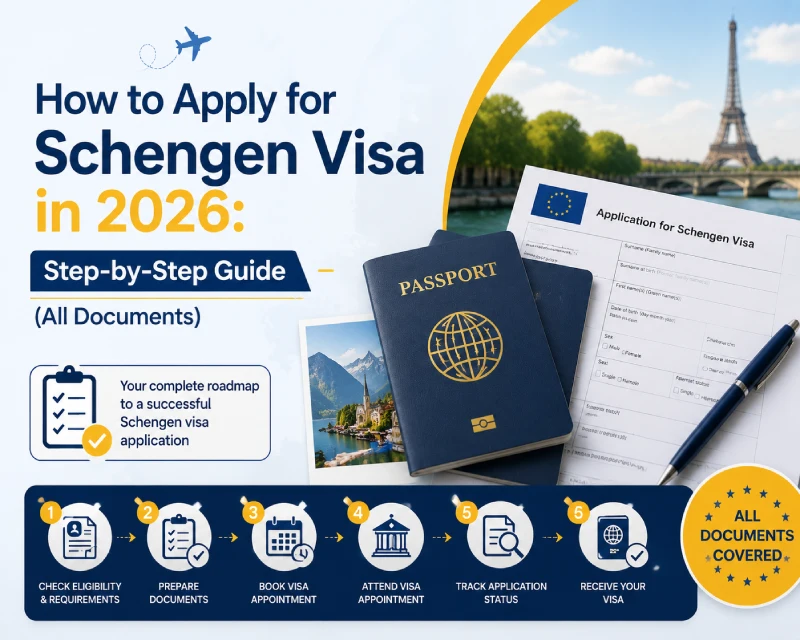

Knowing how to apply for a Schengen visa properly is the difference between a smooth first attempt and a frustrating rejection that costs you weeks of rescheduling. Most people who research how to apply for Schengen visa make the same set of avoidable mistakes.
The Schengen area covers 29 European countries. Getting a visa for any of them follows the same core process, but the details matter. Which embassy you apply through, how far in advance you book your appointment, which documents you submit, and how you present them all affect the outcome.
This guide goes through how to apply for Schengen visa in 2026 step by step, including every document you need and the most common mistakes that cause applications to fail.
What is a Schengen visa and who needs one?
A Schengen visa is a short-stay travel permit that allows entry into any of the 29 countries in the Schengen zone for up to 90 days within any 180-day period. It’s issued by the embassy or consulate of a Schengen member state and covers the entire zone with a single document.
| Schengen visa type | Who it’s for |
|---|---|
| Type C (Short Stay) | Tourism, visiting family/friends, business trips, conferences, medical treatment. Valid up to 90 days in any 180-day period. |
| Type D (National / Long Stay) | Stays longer than 90 days. Issued by the destination country. Each country has its own process. |
| Airport Transit (Type A) | For passing through a Schengen airport without entering the Schengen area. Required for some nationalities. |
| Multiple Entry Visa | Valid for multiple trips within a defined period (1, 2, or 5 years). Still subject to the 90/180 rule per trip. |
Citizens of around 60 countries need a Schengen visa to enter. Nationals of the EU, EEA, Switzerland, USA, Canada, Australia, UK, Japan, South Korea, and several others don’t need one. If you’re unsure whether you need a visa, check the Schengen Visa Checker on the European Commission website using your nationality.
How to apply for Schengen visa: the complete process
The application process has 7 main stages. Follow them in this order.
- Decide which country to apply through. Apply through the embassy of the Schengen country where you’ll spend the most days. If your trip spans multiple countries equally, apply through your first point of entry into the Schengen area.
- Book your visa appointment. Most countries process applications through VFS Global, TLScontact, or the embassy directly. Appointment slots fill up weeks in advance during peak season (May to September). Book as early as possible. The earliest you can apply is 6 months before your trip.
- Gather your documents. The full list is in the section below. The most common delays come from missing or incomplete documents. Go through the checklist twice before your appointment.
- Fill in the visa application form. Most Schengen countries now use an online application form. Fill it in carefully. Inconsistencies between your form answers and your supporting documents are a common reason for refusals.
- Submit your application at the visa centre. Attend your appointment with your original documents and all required copies. Some centres also require your documents in a specific order. Check the VFS or embassy requirements for your country before the day.
- Pay the visa fee. The standard Schengen visa fee in 2026 is EUR 90 for adults and EUR 45 for children aged 6 to 12. Children under 6 are free. Payment is usually made at the visa centre. Some online systems accept card payment during booking.
Complete Schengen visa document checklist for 2026
This is the full list. Some embassies ask for additional documents depending on your nationality, occupation, or travel history. Always cross-check with the specific embassy’s requirements, but every document below is standard across all 29 Schengen member states.
Travel documents
- Passport valid for at least 3 months beyond your return date, with at least 2 blank pages
- Photocopies of all used pages of your current passport
- Old passports showing your previous travel history (originals and copies)
- Flight itinerary for your application showing your entry into and exit from the Schengen area, with a valid PNR code. You don’t need to buy a real ticket.
Visa application form and photos
- Completed Schengen visa application form, signed and dated
- 2 recent passport-size photographs (35mm x 45mm, white background, less than 6 months old)
Accommodation documents
- Hotel reservation for every night of your stay. Covers all countries and cities in your trip. No upfront payment required.
- Invitation letter or host declaration if staying with friends or family (with host’s ID proof)
Travel insurance
- Schengen-valid travel insurance with minimum EUR 30,000 medical cover
- Must include emergency medical evacuation and repatriation of remains
- Valid for all 29 Schengen member states and the full duration of your trip
Financial documents
- Last 3 to 6 months of bank statements showing sufficient funds
- Income tax returns for the last 2 years
- Salary slips for the last 3 months (for salaried applicants)
- For self-employed: business registration, trading licence, or GST/VAT certificates
- Sponsored applicants: sponsor’s bank statements and a signed sponsorship letter
Employment or study status
- Salaried: employer letter confirming leave approval, job title, and monthly salary
- Self-employed: company documents confirming ownership and active trading
- Students: enrolment certificate and NOC from the institution
- Retired: pension certificate or proof of regular income
- Unemployed: proof of funds and a detailed explanation of income source
Civil status and ties to home country
- Marriage certificate (if applicable)
- Birth certificates for children travelling with parents
- Property ownership documents, tenancy agreement, or utility bills in your name
- Evidence of family ties, employment, or business that confirms you’ll return home after the trip
Travel history
- Previous Schengen visas (if any). Copies of visa stickers help demonstrate compliance
- Previous visa refusals must be disclosed on the application form
How to choose which Schengen country to apply through
The rule is simple: apply through the country where you’ll spend the most nights.
For a trip covering France (5 nights), Italy (4 nights), and Austria (2 nights), apply through France. If two countries tie on nights, apply through your first entry point into the Schengen area.
If you’re only transiting through the Schengen area and not staying anywhere, apply through the airport country you’re transiting through.
Why this rule matters
Applying through the wrong embassy doesn’t automatically get you rejected, but it can slow things down significantly. The receiving embassy may forward your application to the correct one, adding weeks to processing time. In some cases, they’ll ask you to reapply.
If your trip isn’t planned yet and you’re flexible on destination, some embassies have faster processing or more available appointments than others. Greece and Portugal typically process applications faster than Germany or France during peak season.
What if I’m applying from a country where my primary destination has no embassy?
Apply through the embassy of a Schengen country that has a representation agreement with your destination. The embassy’s website lists which countries it represents. For example, Iceland’s interests in several countries are handled by Danish embassies.
Schengen visa fees and processing times in 2026
Fees are standardised across Schengen member states. Processing times vary significantly by embassy and season.
| Embassy | Standard fee | Processing time | Priority option? |
|---|---|---|---|
| France | EUR 90 | 15 to 25 days | Yes, through TLScontact |
| Germany | EUR 90 | 15 to 30 days | Limited availability |
| Spain | EUR 90 | 15 to 20 days | Yes |
| Italy | EUR 90 | 15 to 25 days | Yes, selected cities |
| Netherlands | EUR 90 | 10 to 20 days | Yes |
| Greece | EUR 90 | 10 to 15 days | Yes |
| Portugal | EUR 90 | 10 to 20 days | Yes |
| Switzerland | EUR 90 | 15 to 30 days | No standard option |
| Sweden | EUR 90 | 10 to 20 days | Yes |
| Austria | EUR 90 | 15 to 25 days | Limited |
Peak season is May through September. Appointment slots at VFS centres in high-application cities like Mumbai, Delhi, Lagos, Karachi, and Dhaka can fill up 4 to 8 weeks in advance. Book your appointment before you gather your documents, not after.
The EUR 90 fee is non-refundable even if the application is refused. It covers the processing cost, not the outcome.
Common reasons Schengen visa applications get rejected
Around 10% of Schengen visa applications are refused globally. For some nationalities the rate is higher. Most refusals are avoidable.
Incomplete or inconsistent documents
The most common reason. A missing bank statement, a flight itinerary with dates that don’t match your application, or a hotel reservation that doesn’t cover all nights. Go through the checklist line by line. Don’t assume anything is optional.
Insufficient financial proof
Embassy caseworkers assess whether you have enough money to fund your trip without working illegally. There’s no fixed minimum published for every country, but a general rule of thumb is EUR 50 to EUR 100 per day of your stay, plus return fare costs. Clean, stable bank statements matter more than a one-time large deposit.
Weak ties to home country
The embassy needs to be satisfied you’ll return home after the trip. Applicants without steady employment, property, or family in their home country get scrutinised more heavily. A strong employer letter, property documents, or evidence of ongoing commitments helps significantly.
History of visa violations
If you’ve previously overstayed a visa or entered the Schengen area without permission, it will be on record. That doesn’t automatically mean refusal, but it means your application will be reviewed more carefully and you’ll need to explain the history clearly.
Applying through the wrong embassy
Submitting to the French embassy when your primary destination is Germany creates an immediate administrative issue. Double-check your night count before deciding which embassy to apply through.
Travel insurance that doesn’t meet requirements
Policies with coverage below EUR 30,000, geographic restrictions, or missing repatriation wording are rejected. Don’t assume your credit card insurance or domestic health policy qualifies. Check the certificate language carefully.
Tips to improve your Schengen visa approval chances
These come from 11 years of processing documents for applicants from over 100 countries.
Apply early
You can submit your application up to 6 months before your trip. The earlier you apply for Schengen visa during peak season, the better. Waiting until 4 weeks before travel is risky. Appointment slots fill up fast and processing delays are common in summer.
Be specific and consistent across all documents
Your travel dates, accommodation addresses, and flight details must tell the same story across every document. If your flight arrives on June 10, your hotel check-in should be June 10. If your bank statement shows a salary from Company X, your employer letter should come from Company X.
Write a clear cover letter
A 1-page cover letter summarising your travel purpose, planned itinerary, and financial position isn’t mandatory at every embassy but is always helpful. It gives the caseworker context before they go through your documents. Keep it factual and direct.
Don’t underestimate document quality
Bank statements that are difficult to read, blurry photocopies, or printouts that look unofficial create unnecessary doubt. Originals and clean copies only.
Order your travel documents correctly
Some VFS centres have a specific document order they ask for. Check the requirements for your specific centre before organising your file. Submitting in the wrong order doesn’t cause a refusal, but it slows the review down.
Applying for Schengen visa from outside Europe: key differences
The core document requirements are the same regardless of where you’re applying from. A few things vary by country of application.
VFS Global vs direct embassy submission
Most Schengen embassies in Asia, Africa, and the Middle East process applications through VFS Global. Some high-demand embassies in countries like India and Nigeria also use TLScontact. Applications submitted directly to embassy premises are less common in these regions and often require a prior appointment through the same platforms.
Additional country-specific documents
Some embassies require documents specific to your country of application. Indian applicants may need ITR (Income Tax Returns) for 2 years. Pakistani applicants often need a No Objection Certificate from their employer or an NOC from their educational institution. Nigerian applicants may be asked for additional financial documentation.
Check the specific embassy page for your country of application. The base checklist above applies everywhere, but additions vary.
Biometric data collection
First-time Schengen visa applicants need to provide fingerprints and a photograph in person. This can’t be done online. If you’ve provided biometrics in the last 59 months for a previous Schengen application, you may be exempt. Check with your VFS centre.
FAQ’S
How long does it take to get a Schengen visa in 2026?
The minimum processing time is 15 calendar days from the date of your application submission. Standard processing runs 15 to 30 days depending on the embassy and season. Some embassies offer priority processing for an additional fee, which can cut the wait to 7 to 10 days. During peak season (June to August), standard processing can take up to 45 days.
How much does a Schengen visa cost in 2026?
EUR 90 for adults (approximately $97 USD). EUR 45 for children aged 6 to 12. Children under 6 are free. The fee is non-refundable regardless of the outcome. VFS service fees are charged separately and vary by country, typically EUR 15 to EUR 30.
Can I apply for a Schengen visa without a confirmed flight ticket?
Yes. Schengen embassies ask for a flight itinerary, not a purchased ticket. A confirmed reservation with a valid PNR code is the accepted document. Most embassies specifically advise against buying real tickets before the visa is approved.
How many days before my trip should I apply?
Apply as early as possible, up to 6 months before travel. The absolute minimum is 15 days before your intended departure date. For peak season travel (June to September), apply 8 to 12 weeks in advance to account for appointment availability and processing time.
What happens if my Schengen visa is refused?
You’ll receive a written refusal notice stating the reason. You have the right to appeal or reapply. Address the specific reason for refusal in your reapplication. Common fixes include stronger financial proof, a clearer travel itinerary, or better documentation of ties to your home country.
Can I travel to all Schengen countries with one visa?
Yes. A Schengen visa issued by any member state gives you access to all 29 Schengen countries. You don’t need separate visas for each country you visit.
What is the 90/180 rule?
A Schengen visa allows you to stay in the Schengen area for a maximum of 90 days in any 180-day rolling period. It doesn’t reset annually. If you spent 90 days between January and June, you can’t re-enter until enough days have passed in the 180-day window. Overstaying is a serious violation and will affect future applications.
Do I need a new visa application for each Schengen country I visit?
No. One Schengen visa covers all 29 member states. Apply once through the embassy of the country where you’ll spend the most time. The visa is valid for the entire Schengen zone.
Can I extend my Schengen visa after I arrive in Europe?
In exceptional circumstances only: medical emergencies, force majeure events, or humanitarian reasons. Extensions are processed by the immigration authority of the country you’re in when you apply. Standard tourism trips cannot be extended. Plan your travel to stay within the 90-day limit.
Get your Schengen visa documents sorted today
Flight itinerary with verified PNR. Hotel reservations for every night of your stay. EUR 50,000 travel insurance accepted at all 29 Schengen embassies.
Order all three as a complete visa document bundle. One checkout. Everything delivered by email.
Complete bundle (flight + hotel + insurance)
WhatsApp: +1 201-554-8735. Free consultation. Available across all time zones.