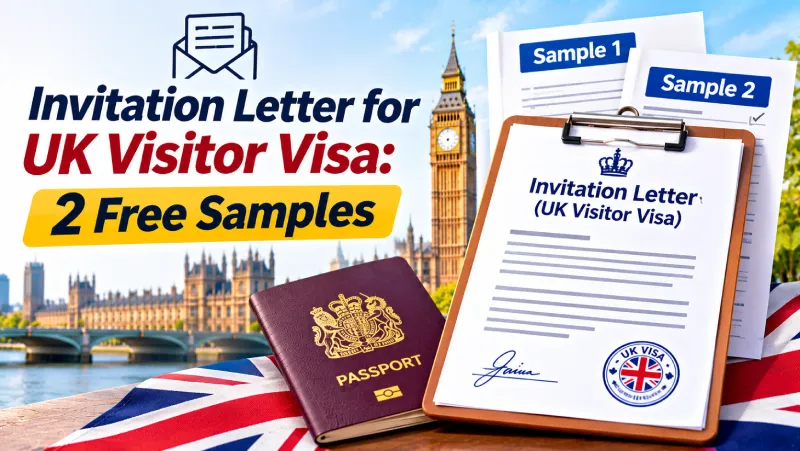

An invitation letter for UK visitor visa applications can explain who you plan to visit, why you are travelling, where you will stay and who will pay for the trip. For a visit to family or friends, ask the person you are visiting to write and sign the letter using details that match your application.
If your sister is offering you a room for two weeks and you are paying for your own flights and meals, write down that arrangement. If she will also cover meals or transport, say which costs she has agreed to pay. This gives UK Visas and Immigration (UKVI) a clear account of what each person will provide.
The first sample below is a fill-in template for a family or friends visit. The second shows how a sibling can offer accommodation while the visitor pays their own expenses.
Is an invitation letter for UK visitor visa applications required?
There is no blanket invitation letter requirement for every Standard Visitor visa application. For a family or friends visit, a letter can support the purpose of the trip and explain the relationship and arrangements. Some activities have specific guidance. For example, UKVI asks business event and conference attendees to provide an invitation from the organiser. GOV.UK guide to supporting documents
UKVI assesses whether the applicant is a genuine visitor coming for a permitted purpose, will leave the UK at the end of the visit and can cover the reasonable costs. Eligible third-party support can count towards those costs. The invitation contributes evidence to that assessment. Immigration Rules Appendix V, paragraphs V 4.2 and V 4.3
What should the host include in the invitation letter?
A short letter is usually enough to set out the facts. Use a date format such as 10 January 2027 so there is no ambiguity about the month and day.
| Detail | What to write |
| Host’s name and contact details | Full name, UK address, telephone number and email |
| Visitor’s name | Full name as shown on the passport, with passport details if appropriate |
| Relationship | How the host knows the visitor, such as sibling or long-time friend |
| Purpose | The reason for the visit and the main planned activities |
| Travel dates | Intended UK arrival and departure dates |
| Accommodation | Address and dates of the stay with the host, plus any nights elsewhere |
| Funding | Who pays for travel, meals, transport and personal expenses |
| Host’s UK status | Accurate details and supporting evidence where relevant |
| Date and signature | The date the host issues and signs the letter |
If a friend is inviting you, a brief sentence about how you know each other can give the letter context. If two relatives are travelling together but only one is staying with the host, name the person the invitation covers. Add the names of any accompanying family members whose stay or costs the host has agreed to support.
Use the real location. If the host lives in Birmingham and the visitor plans a day trip to London, list the Birmingham address as the place of stay. For split accommodation, identify the dates at each place.
Sample 1. Invitation letter for a family or friends visit
The host can adapt this template. Replace the bracketed fields and remove details that do not apply.
[Host’s full name]
[Full UK address and postcode]
[Telephone number]
[Email address]
[Date of issue]
Dear Visa Officer,
I am inviting [Visitor’s full name], my [relationship], to visit me in the United Kingdom from [UK arrival date] to [UK departure date]. [Briefly explain how you know the visitor if helpful.]
The purpose of the visit is [describe the genuine reason]. During the visit, we plan to [briefly describe the family visit or other planned activities].
[Visitor’s name] will stay at my home at [full address] from [start date] to [end date]. [If applicable, give details of any part of the trip spent at a different address.]
I will provide [accommodation and any specific expenses you will cover]. [Visitor’s name] will pay for [the expenses the visitor will cover]. [If relevant, explain how and when you will pay any costs you are covering.]
[If relevant, state your citizenship or UK immigration status accurately and identify any supporting documents enclosed.]
Please contact me at the telephone number or email address above if you need further information about the visit.
Yours faithfully,
[Signature]
[Host’s full name]
Sample 2. Invitation letter from a UK resident for a sibling
This fictional example shows how to record accommodation support and identify the expenses the visitor will fund.
12 November 2026
Dear Visa Officer,
My name is Rahul Sharma and I live at [full London address and postcode]. I am inviting my sister, Priya Sharma, to visit me in the United Kingdom from 10 January to 25 January 2027.
Priya plans to spend time with me and do some sightseeing in London. She will stay at my home from her arrival on 10 January until her departure on 25 January.
I will provide accommodation at my home for the duration of the visit. Priya will pay for her return flights, meals, local transport and personal expenses from her own funds.
I hold [accurate UK immigration status]. [Identify any relevant supporting evidence actually enclosed.] Please contact me if you need to confirm the arrangements for her stay.
Yours faithfully,
[Signature]
Rahul Sharma
[Full UK address and postcode]
[Telephone number]
[Email address]
The same format can work for an adult child visiting a parent or a friend visiting a UK resident. Change the relationship, address, purpose and funding details to reflect the trip.
Invitation letter and sponsorship letter
A UK visitor visa invitation letter explains the proposed visit and relationship. A sponsorship letter explains the support someone will provide, such as paying for return travel or giving the visitor a place to stay. The host can describe both in one letter when they are the person providing the support.
The visitor pays all trip costs
A host can invite a friend or relative who plans to stay elsewhere and cover their own trip costs. State the arrangement plainly. For example, “I am inviting my cousin to visit me during her holiday. She will arrange and pay for her accommodation and travel.”
The host provides accommodation
Say where the guest will stay and for which dates. If the visitor will pay for the rest of the trip, list those expenses. UKVI’s sponsorship guidance covers accommodation support as well as money or travel support. GOV.UK guidance on visitor sponsorship
The host also pays some or all expenses
Name the costs and explain how they will be paid. If the host will pay directly for meals and local travel during the stay while the visitor buys their own return flight, use that wording. If the support extends to a dependant travelling with the visitor, explain what is covered for that person as well.
Under Appendix V, a third party providing support must have a genuine personal or professional relationship with the applicant, comply with immigration law at the relevant times and be able and willing to provide the agreed support throughout the intended stay. Immigration Rules Appendix V, paragraph V 4.3
What evidence should the host and visitor provide?
Where someone provides travel, living costs or accommodation, UKVI asks for evidence of what is offered, how it will be provided, the relationship and the sponsor’s ability to support themselves and their dependants. Evidence of lawful UK status is relevant where applicable. Select documents that support the actual arrangement. GOV.UK guide to supporting documents
- Identity and UK status. Include relevant evidence, such as a British passport or appropriate proof of UK status, where applicable.
- Relationship. Choose evidence that fits the relationship and any instructions for your application.
- Accommodation. Make sure any evidence supplied for a stay with the host shows the address used in the invitation.
- Funds. If the host will pay expenses, choose financial evidence that supports the commitment. The visitor should be able to explain the source of funds they will use for their share.
The visitor should also explain their own circumstances. Employment or study evidence may help if it relates to the application. A self-employed applicant might use genuine business records where relevant. State the proposed departure date in the invitation and use the visitor’s own evidence to explain their plans after the trip. GOV.UK guidance on demonstrating personal circumstances
Match the letter to the application before submitting
1. Check names, dates and addresses
Compare the invitation with the application form. Check the visitor’s passport spelling, the UK arrival and departure dates and each place they plan to stay. If an overnight flight is part of the trip, use the expected date of arrival in the UK in the letter. For organising proposed routes and dates, see our guide to preparing a flight itinerary.
2. Compare the funding statements
Read the visitor’s estimate of trip costs alongside the host’s promises. If the host will only offer a room, the application should explain how the visitor will cover the other expenses. The Standard Visitor application asks about the planned trip, including where the applicant will stay and the estimated cost. GOV.UK Standard Visitor visa application guidance
3. Follow UK guidance on booking documents
Use intended travel dates for the invitation. UKVI lists hotel bookings and flight bookings, except for transit, among documents that are less useful as evidence for a visit application. Check your route’s instructions before buying a ticket or paying for a reservation. GOV.UK list of less useful documents For a comparison across destinations, see applying for a visa without buying a flight ticket.
4. Have the host review and sign the letter
Ask the host to confirm the facts, contact details and commitments before signing. Keep a copy of the final version. If the itinerary changes, update the invitation and application details as appropriate. For help interpreting booking terminology, see our guide to visa and flight reservations.
What if the visitor is under 18?
For a child travelling without a parent or guardian, include a signed consent letter from a parent or guardian. The consent and supporting documents should explain travel and care arrangements, including who will accompany the child, if anyone, and who will look after them in the UK. If the host will care for the child, make sure the name, address and dates agree across the documents. GOV.UK Standard Visitor guidance for under-18s
Frequently asked questions
Can a friend write a UK visitor visa invitation letter?
Yes. A friend can explain how they know you, why you are visiting and whether they will host you or help with costs. Give the actual arrangements and use supporting evidence where relevant.
Does the host have to be a British citizen?
A lawful UK resident can invite a visitor. When that person will provide travel, living costs or accommodation, check the third-party support conditions and include evidence of lawful status where applicable
Does a UK visitor visa invitation letter need to be notarised?
GOV.UK’s general visitor guidance does not prescribe notarisation for an ordinary personal invitation and lists notarial certificates among less useful evidence. Ask the host to sign and date the letter and follow the instructions for your application
Can I pay for my flights while my host provides accommodation?
Yes, when that is your genuine arrangement and you meet the visitor requirements. Have the host state the address and dates of the stay. Explain how you will pay for the flights and any other expenses you will cover.
Can I reuse an invitation letter for a later trip?
Ask the host to update it when the dates, purpose, address or funding arrangements change. Check that the version you submit reflects the new application and identifies any supporting documents actually enclosed.
Does an invitation guarantee approval?
UKVI decides based on the whole application. The letter can help explain the visit, while the applicant must still satisfy the Standard Visitor requirements.