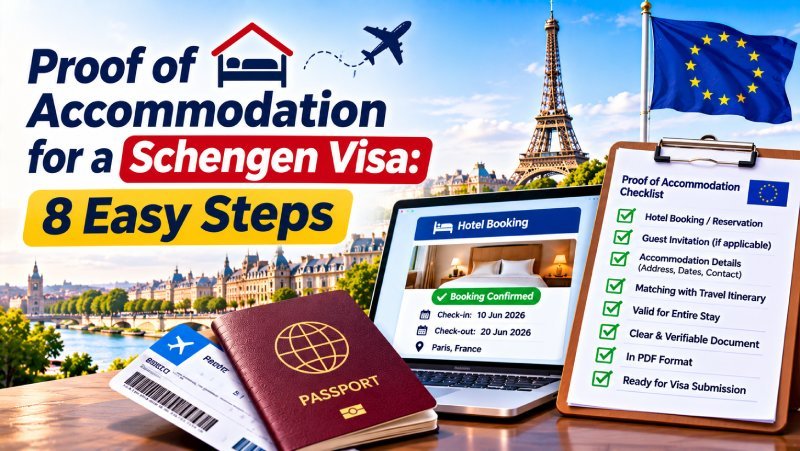

Proof of accommodation for a Schengen visa shows where you intend to stay during your trip. Depending on your arrangements and the destination’s checklist, this can mean hotel confirmations, rental documents, a tour confirmation or official paperwork from a private host. Prepare evidence for the accommodation you actually plan to use and account for the relevant nights.
Start with the current checklist for your visa category and place of application. It will tell you which documents, formats and host formalities apply to your circumstances.
What counts as accommodation proof?
The European Commission lists accommodation alongside travel purpose, financial means and intention to return among Schengen supporting documents. Detailed requirements come from the responsible embassy or consulate. European Commission application guidance
Use your genuine arrangement to decide what to prepare.
| Planned accommodation | Evidence to check with your mission |
| Hotel, hostel or guesthouse | Booking confirmation identifying the traveller, property and dates |
| Holiday apartment or rental | Reservation confirmation or rental agreement with the address and stay dates |
| Family or friend’s home | Required invitation or official private-accommodation documents |
| Organised tour | Tour confirmation identifying the accommodation included |
| Your own property | Ownership evidence and details requested by the checklist |
| A mixture of arrangements | Separate documents covering the relevant parts of the trip |
For example, the Dutch government’s general tourism checklist asks hotel and rental guests for a reservation or rental agreement covering the trip. It also recognises property ownership evidence. Select your country of residence to check the applicable process. Dutch tourism checklist
A property listing helps you choose somewhere to stay. Once you book, retain the confirmation issued for your dates and guests. Check any document called a “voucher” carefully to establish what it confirms and whether it meets your checklist.
Prepare proof of accommodation for a Schengen visa in 8 steps
1. Read the checklist for your actual application
Find the official requirements for your destination, visa category and place of submission. Look for the accommodation section and any separate instructions for private visits, sponsorship or organised tours.
Save the list with your working documents. Check whether the mission requests an original, a copy, a translation or a national host form. Allow time for a host to obtain and send documents if those formalities apply.
If you have a mixed trip, review each arrangement before booking. A hotel confirmation for the first stop will explain only that part of the visit.
2. Put the route and overnight dates in order
Write down where you intend to be each night, starting with arrival and ending with departure. Separate hotel nights from travel days so overnight flights or trains are easy to understand.
For a multi-country visit, check the country responsible for your application. Main purpose matters. Where the purpose is the same across countries, apply to the longest-stay destination; for equal stays, use the first country visited. Main-destination guidance
Use the actual days, purpose and transfer timings to assess responsibility. Accommodation nights help organise the route, but they are only part of that assessment.
3. Obtain the appropriate confirmation
Book the accommodation you intend to use, or ask your host or tour operator for the required documents. Keep the original confirmation email or file from the issuer.
If you use a booking platform, check that the confirmation identifies the property and your reservation. A pending request may need further action before the property confirms it.
For a tour, ask for details covering the accommodation included and any nights you must arrange separately. Check arrival-day and final-night arrangements rather than assuming the package covers every night in your application.
4. Check the guest and property details
For a hotel booking for Schengen visa purposes, review these fields where relevant:
- Guest names corresponding to the travellers’ passports.
- Property name and full address.
- Check-in and check-out dates.
- Number of guests and rooms.
- Reservation reference and status.
- Issuer or property contact information.
These are practical review fields. Your checklist may request additional details. If a family booking names only the lead guest, ask the issuer to include the other travellers where needed.
Ask the hotel or booking provider to correct errors through its own system, then check the updated confirmation. Keep the current version with your application documents.
5. Complete private-host formalities
If you will stay with family or friends, ask which official host documents apply before relying on a simple invitation email. Requirements vary by destination and circumstances.
France-Visas explains that a private host obtains the relevant accommodation document from their local town hall. Its FAQ asks applicants to have the original for submission and entry. Check your personalised application requirements and any exemption that applies to your situation. France-Visas hosting guidance
For a Dutch visit requiring private-accommodation proof, the host completes a form. Visa-required visitors need the form legalised at a Dutch municipality, with the original sent to the visitor. The guidance explains the copy and original requirements for submission and travel. Dutch private-accommodation procedure
Hosting and financial support can involve separate evidence. Explain whether the host supplies a room, pays accommodation costs or also covers other expenses.
6. Compare accommodation with your transport
Check the local arrival date on the flight you intend to take. A late departure from home may reach Europe the following day. Your first overnight arrangement should follow the actual arrival.
Do the same for departure. A flight leaving at 00:30 on 21 December creates a different final-night plan from one leaving at 18:00 that day. Work out the genuine arrangement and explain it if the dates could be confusing.
Compare each transfer with the next check-in date. Use the same route in your cover letter and travel plan. Our guide to flight itinerary and booking documents explains the different documents you may be comparing.
7. Review payment and cancellation terms
Read whether your checklist requires a reservation, confirmed accommodation or proof of payment. Then check the property’s actual terms before committing money.
For a cancellable reservation, note the deadline, local time zone, deposit requirements and any charges. Set a reminder if you need one. Keep your confirmation current if the booking requires further action to remain active.
For example, if a property allows free cancellation until 18:00 local time on 8 December, record that deadline exactly. Check whether the rate requires a card guarantee, a deposit or payment on arrival. If your application is still pending near the deadline, review your booking options and the visa office’s update instructions before making a change. A service fee charged by an intermediary may have separate refund terms from the room reservation.
The price paid for a reservation does not determine whether it satisfies the document requirement. Check that the confirmation represents your intended stay and meets the requested format. The same care applies to transport costs when arranging a trip before the visa decision. See our guide to applying without purchasing the full flight ticket.
8. Review the complete submission set
Put your Schengen visa accommodation proof beside the application form, cover letter, transport evidence and daily itinerary. Check names, dates, countries and who pays.
Account for each relevant night with a hotel, rental, host or genuine overnight-travel arrangement. Resolve unexplained gaps and remove superseded documents from the submission set.
Save the final version. If the visa office later asks for an update, you can identify the change and provide current evidence in its requested format.
Example of accommodation covering a multi-city trip
Suppose you intend to arrive in Paris on 10 December 2026 and depart Amsterdam on 21 December. This illustrative plan accounts for the accommodation nights without supplying fictional hotel confirmations.
| Location | Check-in | Check-out | Nights | Evidence to obtain |
| Paris | 10 December | 15 December | 5 | Confirmation from the selected property |
| Brussels | 15 December | 18 December | 3 | Confirmation from the selected property |
| Amsterdam | 18 December | 21 December | 3 | Confirmation from the selected property |
The trip covers 12 calendar dates and 11 accommodation nights. France is the longer tourism stay in this example. Check actual transport, transfer days and purpose when confirming the application country.
If a relative hosts you in Paris for two nights, replace that part of the plan with the genuine host arrangement and required evidence. The Paris hotel would then cover only the nights you actually intend to spend there.
Check flight availability and local arrival dates before using a similar route. Our guide to flight reservation requirements can help you review the transport evidence alongside the accommodation.
What if you use an apartment or holiday rental?
Check whether your destination accepts the arrangement and what confirmation details it requests. The Dutch general checklist, for example, includes rental accommodation. The relevant local checklist should guide the final submission.
Ask for a confirmation or rental agreement showing your stay dates and the information the mission needs. If the confirmation obscures the address or names only one guest, ask the provider how to obtain the required details.
Keep the document issued for the actual reservation. A property advertisement, saved listing or enquiry message may help you plan, but check that the evidence you submit shows the arrangement requested by the visa authority.
What if a booking changes or is cancelled?
If the property cancels, arrange replacement accommodation that fits your real plans. Review the related itinerary and budget, then check the visa office’s instructions for updates if you have already applied.
If you change hotels after approval, retain current confirmations and check any significant change with the issuing mission, especially if it affects the trip’s purpose or main destination. A routine property change and a redesigned multi-country trip involve different facts for the mission to assess.
Carry the relevant evidence for the journey you will actually make. France’s official arrival guidance says border police may ask for accommodation covering the stay, among other supporting documents. Arrival in France
Accommodation mistakes to check before submission
| Issue | What to review |
| Only the first night is documented | Account for the remaining overnight arrangements |
| Flight and hotel dates differ | Check local dates and explain any host stay or overnight travel |
| A traveller is missing from the booking | Ask the issuer to add the guest details required by the checklist |
| Host paperwork is incomplete | Review the destination’s national form and legalisation requirements |
| A confirmation is still pending | Check the actual status with the property or issuer |
| Payment or cancellation action is due | Complete the genuine booking requirements and retain the current confirmation |
| The route changes between documents | Reconcile the application, transport, hotels and cover letter |
Never fabricate a booking reference, host document or confirmation. Obtain corrections and replacements from the relevant issuer.
Frequently asked questions
Can I combine hotel stays with nights at a friend’s home?
Yes. Show the hotel evidence for the hotel nights and the required host documentation for the private stay. Make the dates and transfer clear in the itinerary, including any national form the destination requires.
What if someone else booked the room for me?
Ask for confirmation that identifies you as a guest where required. Explain who is paying and provide the financial or sponsorship evidence requested. A payer’s name and a guest’s name can refer to different people, so make both roles clear.
Does every traveller need their own hotel booking?
Check the mission’s instructions for group or family bookings. A shared hotel confirmation may cover several guests when the required names and stay details are present. Private-host forms can have different rules, so check those separately.
Can I apply before choosing every hotel?
You can plan your route before booking. For submission, provide the accommodation evidence your current checklist requests. If part of the trip has another arrangement, explain it with the appropriate documents instead of leaving the dates unexplained.
Is a free-cancellation booking automatically acceptable?
Check the full requirement. Cancellation flexibility helps manage your booking, while the mission assesses whether the accommodation document supplies the requested evidence. Confirm the status, guest details, address and dates before submitting.
Does accommodation proof guarantee approval?
The decision depends on the whole application and applicable requirements. Accommodation evidence explains where you will stay. Review it alongside the requested financial, travel-purpose and other supporting documents.