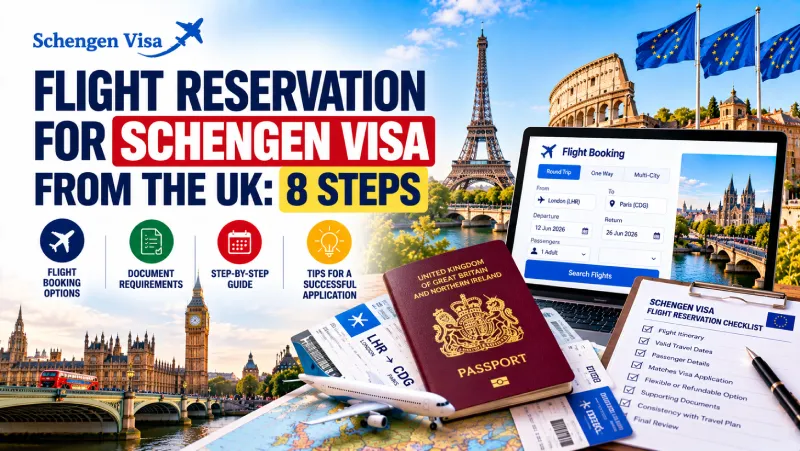

A flight reservation for Schengen visa from the UK should identify you and show your intended journey, including return or onward travel where requested. You do not automatically need to buy a non-refundable ticket. Follow the current checklist for your destination, visa category and place of application before arranging travel evidence.
This guide is mainly for people living legally in the UK whose nationality or circumstances require a Schengen visa. It explains booking documents, UK residence evidence, choosing the correct application country and checking that your travel dates agree.
Who needs this reservation when applying from the UK?
UK residence and British citizenship are different. Living in London, Manchester or another UK city does not by itself decide whether you need a Schengen visa.
For ordinary short visits, full British citizen passport holders can generally visit the Schengen Area without a visa for up to 90 days in any 180-day period. Other passport categories, work and longer stays need separate checks. See the UK government’s France entry guidance, which identifies the passport holders its advice covers.
If you hold another nationality, check your visa requirement before paying for reservation documents. Some non-British residents are also visa-exempt or qualify for specific exemptions.
The European Commission’s application guidance says applications normally go to the consulate responsible for your country of legal residence. Being in the UK as a visitor does not automatically make the UK the correct place to apply.
Do you need a paid flight ticket or a reservation?
Read the exact instruction rather than treating “ticket,” “reservation” and “itinerary” as interchangeable.
For example, the Dutch government’s general tourism checklist says a reservation in your name or another document showing travel plans is needed, and that a paid ticket is unnecessary. Its UK-specific checklist has its own wording, so use the version that applies to you.
If your mission requests a reservation, provide authentic booking evidence meeting that request. If it requests proposed travel details, label an unreserved itinerary accurately. Ask the mission about unclear wording before purchasing a product solely for the application.
Our guide to applying for a visa without buying a flight ticket explains the practical difference between showing a plan and committing to airfare.
Flight reservation, itinerary and ticket: what changes?
| Document | What it represents | What it does not establish by itself |
| Proposed itinerary | A journey you intend to take | A reserved seat or issued ticket |
| Temporary reservation | An actual booking subject to a deadline or conditions | Indefinite validity or completed ticket issuance |
| Issued ticket | Ticketed travel under the applicable fare conditions | Visa approval or unconditional refund rights |
| Search screenshot | Flight options displayed at a particular time | A booking in your name |
An agency service charge is also different from paying the airfare. Ask what the quoted price covers and whether the resulting document is a proposal, hold or issued ticket.
The phrase “dummy ticket” is used inconsistently. It might describe a genuine temporary booking, but it can also describe an unreserved example or fabricated document. Our guide to dummy tickets versus real flight bookings explains that distinction.
Never submit invented booking references or alter a confirmation to make it appear current.
Prepare your flight reservation for Schengen visa from the UK in 8 steps
1. Identify the correct destination country
Your application country should follow your actual trip. The Dutch government’s multi-country guidance explains that the main purpose matters. For a holiday with the same purpose throughout, apply to the country with the longest stay; for equal stays, use the first country visited.
A business trip followed by a holiday can require a different assessment from a tourism-only route. Do not choose a mission simply because it has an earlier appointment.
Write down the purpose, dates and countries first. That makes it easier to check which mission should handle the application before preparing bookings.
2. Check the current UK application checklist
Find the embassy or authorised application centre’s instructions for your visa category. Save the relevant checklist and check whether there are separate requirements for applicants living in the UK.
Highlight its transport wording. Note whether it asks for flights, return travel, onward evidence or a broader itinerary. Also check the requested format and supporting documents.
Use our overview of flight reservations and embassy requirements for terminology, then return to your destination’s official instructions for the final decision.
3. Prepare your UK residence evidence
Do not rely on an old physical residence card as your only evidence without checking the current process.
The Netherlands tourism checklist for UK applicants includes a UKVI eVisa printout and letter with a share code, with status valid at least one month after leaving Schengen. That is a Dutch checklist example, not a universal validity rule for every mission.
Check your destination’s own residence-validity requirement. Keep names and passport details consistent across the application and status evidence, and use the requested type of share code.
For the eventual journey, review GOV.UK guidance on travelling with an eVisa. It says to travel with a valid passport or travel document added to your UKVI account.
4. Choose realistic travel dates and airports
Select dates that fit your leave, budget and planned stay. Include the time needed to reach the UK departure airport and return home afterwards.
Specify the actual airport. London Heathrow and London Gatwick are different departure points; a document that simply says “London” may hide an error when compared with the booking.
If you leave on an overnight flight, check the local arrival date. Accommodation and the daily itinerary should follow where you will actually be, rather than copying the departure date into every field.
5. Obtain the requested document
Where a reservation is required, ask the airline or provider what booking it will create, how long it lasts and how you can check its status.
Review these fields where applicable:
- Passenger name matching the passport record.
- Departure, connection and destination airports.
- Local travel dates and scheduled times.
- Airline and flight numbers for each segment.
- Return or onward route.
- Booking reference, current status and ticketing deadline.
These are practical review fields, not a claim that every checklist requires every item. Have the issuer correct errors. Do not fill gaps with invented information.
6. Include connections and onward travel
Show the complete relevant route, even if separate bookings cover different segments. Check airport changes, baggage collection and overnight transfers before selecting a connection.
If you will leave Schengen for another destination, explain that journey instead of adding a UK return you do not intend to take. Check the onward country’s entry requirements separately.
The UK-specific Dutch checklist requests a reservation and travel plan showing return to the UK or onward travel. Do not assume a document suitable for one mission satisfies another mission’s wording.
7. Match the reservation to the rest of the application
Put your Schengen visa flight reservation from UK beside the other documents and check for contradictions.
| Supporting document | What to compare |
| Application form | Dates, countries and personal information |
| Cover letter | Purpose, route and who pays |
| Accommodation | Locations and nights throughout the stay |
| Travel insurance | Geographic scope and travel dates |
| Employment or study evidence | Absence and expected return |
| Invitation, where relevant | Host details and visiting dates |
| UK residence evidence | Identity and applicable status-validity requirements |
For Dutch UK tourism applications, the checklist specifies insurance across all Schengen countries for the stay, with at least €30,000 medical cover including repatriation. Follow the insurance instructions applicable to your application.
8. Recheck the booking before submission
Confirm that the document still reflects your intended trip. If the reservation has a deadline, check its status with the issuer rather than assuming it remains active.
Save the final documents together and remove superseded versions from the submission set. If one travel date changes, review the related hotel, insurance and leave documents again.
If the visa office later requests updated evidence, follow its instructions and deadline. Obtain an accurate replacement from the issuer when necessary.
Example: London, Paris and Rome
This is an illustrative tourism plan, not a verified flight schedule or a booking confirmation.
| Date | Proposed movement or stay | Accommodation |
| 10 December 2026 | London to Paris | Paris, check-in 10 December |
| 10–15 December | Sightseeing in Paris | Five nights in Paris |
| 15 December | Paris to Rome | Rome, check-in 15 December |
| 15–21 December | Sightseeing in Rome | Six nights in Rome |
| 21 December | Rome to London | Checkout in Rome |
Italy is the longer stay in this tourism-only example, so Italy would generally handle the application under the main-destination rules. Landing in France first does not by itself make France responsible.
The trip covers 12 calendar dates and 11 accommodation nights. When applying the rules, review the actual days and purpose, including transfer days, rather than relying on hotel-night totals alone. The Visa Code’s competence rule assesses the main destination by duration counted in days or purpose.
Check real flight availability before using a similar route. Your international and intra-Schengen transport should agree with the order of the hotels and activities.
Does your reservation need a PNR?
A Passenger Name Record is a booking record. The reference or record locator shown on a confirmation identifies it; different booking systems may provide different references.
A reference can help retrieve a booking, but it does not by itself prove that a ticket was issued or that the reservation remains active. Ask the issuer how to check it.
Follow any specific checklist requirement. If a reservation cannot be retrieved on the airline website, seek clarification from the issuer rather than inventing a replacement reference or assuming the website result explains everything.
How long should the reservation remain valid?
There is no single hold period that applies to every airline booking. Check the actual ticketing deadline and conditions before paying a service charge.
A short hold should not be advertised or treated as valid throughout an uncertain processing period. Ask what happens if your appointment moves, whether a replacement is available and what it costs.
Keep reservation status separate from visa validity. After a decision, review the issued visa and your actual travel arrangements before making final purchases.
Final document checks for UK applicants
Before submitting your flight itinerary for Schengen visa from UK, review these points against the documents themselves:
- Your name is accurate across the passport and booking.
- The intended application country matches the genuine trip.
- Each relevant transport segment is explained.
- Accommodation accounts for the planned nights.
- Insurance fits the applicable geographic and date requirements.
- Leave or study documents fit your absence.
- UK residence evidence follows the destination’s current instructions.
- A proposed itinerary is not presented as a confirmed reservation.
- Any booking reference and status information came from the issuer.
- The final file contains one coherent version of the plan.
If you find a gap, explain the real arrangement. Staying with a host, taking an overnight journey or departing from another city can be reasonable, but the documents should make that clear.
Frequently asked questions
Can I use a flight search screenshot?
A search result shows an available option, not a reservation in your name. If the checklist requires a booking, do not substitute a price screenshot. Ask the mission if its wording allows proposed travel details instead.
Can I arrive in one Schengen country and leave from another?
Yes, an itinerary can include different entry and departure countries. Explain the complete route and apply through the country responsible for your actual purpose and duration of stay.
Can I apply in the UK but depart from another country?
Your departure point and application location are separate questions. Explain the real route, check eligibility to apply in the UK and review entry or transit requirements for countries involved before reaching Schengen.
What if my reservation expires while I wait?
Ask the issuer to confirm its status. Follow any visa-office request for current evidence. Do not edit an old confirmation or automatically submit multiple replacements without checking the office’s instructions.
Do I need a flight reservation if I travel by train or ferry?
Use evidence of your actual transport in the form requested by the mission. Do not reserve a flight just to make a train or ferry journey resemble air travel. Check what the relevant transport checklist requires.
Does paying for flights improve the chance of approval?
A paid ticket does not guarantee approval. The authority assesses the complete application. Choose travel evidence that meets the instructions and describes your genuine plans, and understand the fare conditions before committing money.